
ION meaning usage examples pop up everywhere online, from group chats to Instagram comments, and most people see the word before they understand it. You open a chat, someone types “ion,” and you pause. Is it slang? Is it science? Is it a typo?
It’s actually both, depending on where you see it. In texting, “ion” is a fast, casual way of saying “I don’t.” In science class, “ion” means something completely different — a charged particle that shows up in chemistry, physics, and even your own body.
This guide breaks down every meaning of ION, with real examples, comparison tables, and country-specific usage notes, so you never have to guess again. By the end, these ION meaning usage examples will cover slang, science, and everything in between.
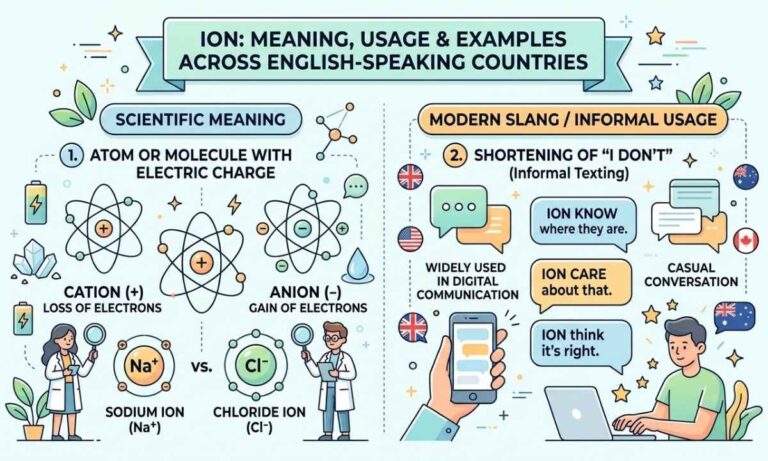
Quick Answer: These ION meaning usage examples show that ION usually means “I don’t” in texting slang. In science, an ion is an atom or molecule with an electric charge. The right meaning depends entirely on context.
What Does ION Mean in Text?
In texting and social media, ION is shorthand for “I don’t.” People type it exactly how it sounds when spoken fast in casual speech.
Say “I don’t know” quickly out loud. It often blends into something close to “ion know.” That’s where the spelling comes from.
This usage is rooted in African American Vernacular English (AAVE) and became widespread through TikTok, Instagram, and Snapchat around the late 2010s. It’s now common across Gen Z and younger millennial texting everywhere.
Example: “ion think that’s a good idea 😅”
In short: ION = I don’t = a quick, informal way to express doubt, disagreement, or disinterest.
ION almost always sits at the start of a sentence and works exactly like “I don’t” would, just shorter and more casual. These early ION meaning usage examples set the tone for everything that follows in this guide.
Ion Meaning in Human Body
Ions aren’t just internet slang — they’re essential to how your body actually functions.
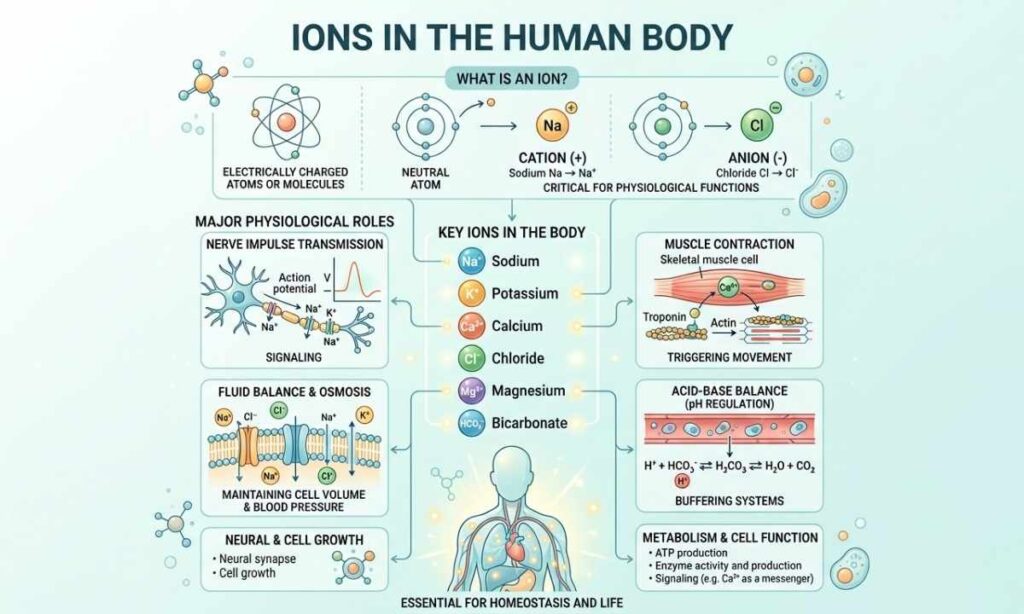
Inside the human body, ions like sodium, potassium, calcium, and chloride carry electrical charges through fluids and cells. These charged particles are often called electrolytes.
Here’s what they actually do:
- Sodium and potassium ions help nerves send electrical signals to the brain and muscles.
- Calcium ions trigger muscle contractions, including your heartbeat.
- Chloride ions help balance fluids and maintain healthy blood pressure.
- Magnesium ions support energy production and muscle relaxation.
Without these ions moving in and out of cells, your heart couldn’t beat, your muscles couldn’t move, and your brain couldn’t send signals. That’s why sports drinks and IV fluids are loaded with electrolytes — they’re replacing lost ions. This is one of the clearest ION meaning usage examples from science, showing how far the word travels from slang to biology.
Ion Meaning in Chemistry
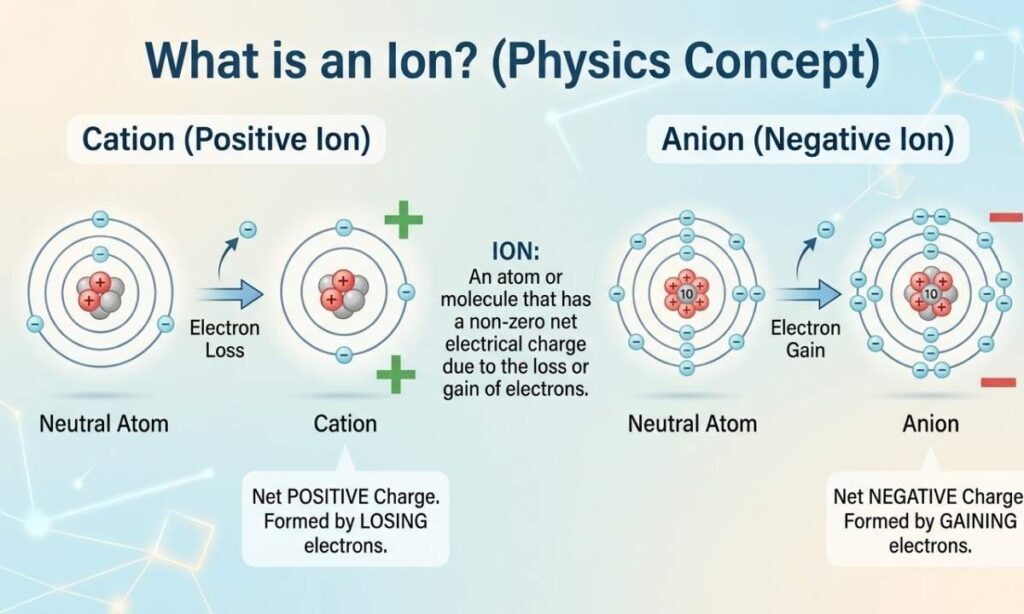
In chemistry, an ion is an atom or molecule that has gained or lost one or more electrons, giving it an electric charge.
A normal atom has equal protons and electrons, which cancels out to a neutral charge. Remove or add an electron, and that balance breaks.
There are two main types:
| Type | Charge | How It Forms | Example |
|---|---|---|---|
| Cation | Positive (+) | Atom loses electrons | Na⁺ (sodium) |
| Anion | Negative (−) | Atom gains electrons | Cl⁻ (chloride) |
Table salt (sodium chloride) is a classic example. Sodium loses an electron to become a cation, and chlorine gains one to become an anion. The two opposite charges bond together, forming the salt you use in your kitchen.
Chemists also study polyatomic ions, which are made of multiple atoms sharing one overall charge, like sulfate (SO₄²⁻). Salt formation is one of the most widely taught ION meaning usage examples in any chemistry classroom.
Ion Meaning in Physics
In physics, the definition stays close to chemistry, but the focus shifts to how ions behave in electric and magnetic fields.
An ion is any charged particle capable of conducting electricity or reacting to an electric field. This matters in areas like plasma physics, electricity, and atmospheric science.
A few real-world physics examples:
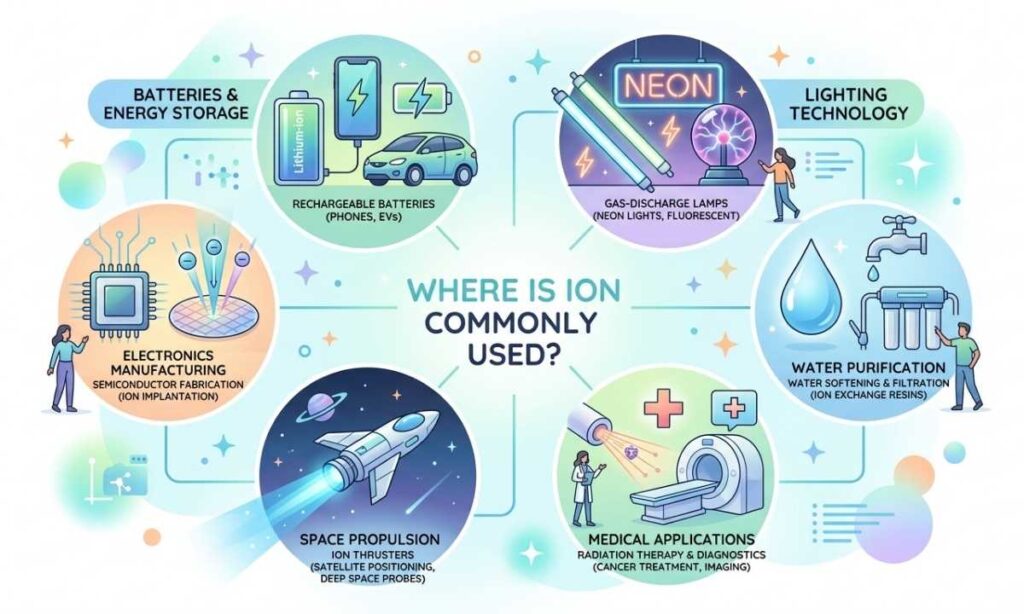
- Lightning creates ions in the atmosphere as electrical charge builds up and discharges.
- Neon signs glow because gas atoms inside the tube become ionized and release light.
- Batteries rely on ion movement between electrodes to generate electrical current.
- Plasma, the fourth state of matter found in stars, is essentially a cloud of ions and free electrons.
The word “ion” itself comes from the Greek word for “to go,” coined by physicist Michael Faraday in 1834 to describe how charged particles travel toward electrodes. Lightning and neon signs remain two of the most visible ION meaning usage examples in everyday physics.
Also Read This Myh Meaning In Text
How ION Became Popular Online
Slang doesn’t spread overnight. ION built momentum slowly through spoken speech before it ever showed up in a caption.
Linguists trace the pattern back to AAVE, where phrases like “I don’t” naturally blend together in fast, casual speech. Over time, that sound got typed exactly as it was heard.
Once TikTok and Instagram took off in the late 2010s, casual typing styles spread fast. Creators used ION in captions and comments, and younger audiences picked it up almost instantly.
By the early 2020s, ION had become a standard part of Gen Z texting vocabulary, alongside terms like “fr,” “no cap,” and “bet.” It’s one of many examples of how internet culture reshapes everyday language.
Where Is ION Commonly Used?
The slang version of ION lives almost entirely in casual, informal spaces. You won’t find it in textbooks or business emails.
Common places you’ll spot it:
- 📱 Text messages between friends
- 👻 Snapchat chats and streaks
- 🎵 TikTok comments and captions
- 📸 Instagram DMs and reels
- 🎮 Discord and gaming chats
The tone is always relaxed, playful, and conversational — never formal.
ION Meaning Usage Examples in Conversation
Seeing ION in real dialogue makes the meaning click faster than any definition. Here are a few natural ION meaning usage examples:
Example 1 A: you coming to the party tonight? B: ion think so, i’m tired 😩
Example 2 A: why you so quiet today? B: ion got nothing to say fr
Example 3 A: do you like him?? 👀 B: ion like him like that lol
Example 4 A: you finished the assignment? B: ion even start yet 😭
Example 5 A: wanna watch a movie? B: ion mind, you pick 🎬
Each example swaps “I don’t” for “ion” without changing the meaning at all. It just sounds more relaxed. Practicing with a few ION meaning usage examples like these makes the slang feel natural within a day or two.
Meaning of ION in English-Speaking Countries
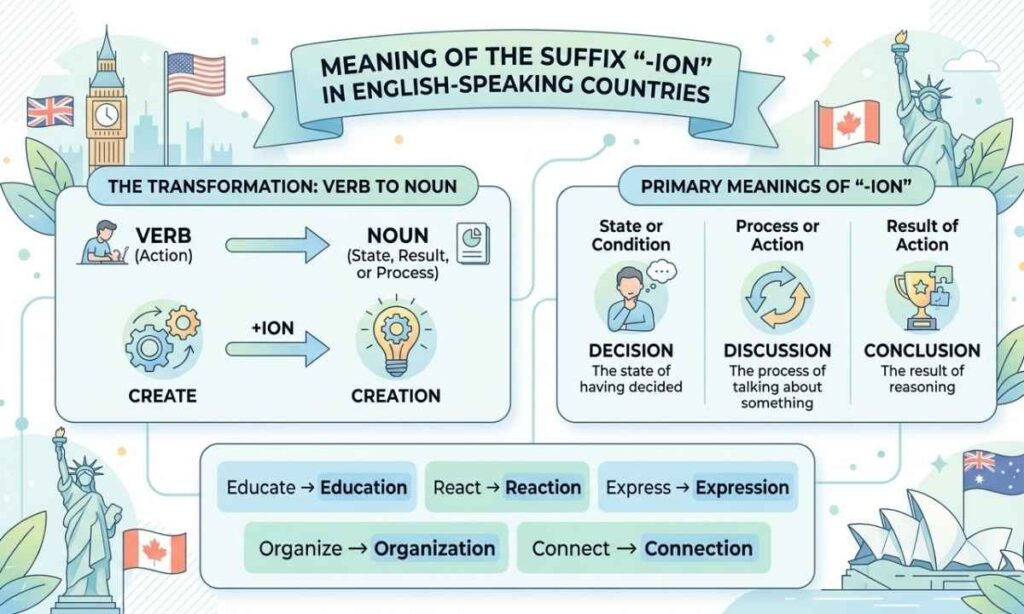
ION’s slang meaning doesn’t really shift across borders. It stays “I don’t” almost everywhere English is spoken online.
| Country | Meaning of ION | Notes |
|---|---|---|
| 🇺🇸 United States | I don’t | Most common origin point; widespread in Gen Z texting |
| 🇬🇧 United Kingdom | I don’t | Popular among younger users on TikTok and Snapchat |
| 🇨🇦 Canada | I don’t | Nearly identical usage to the US |
| 🇦🇺 Australia | I don’t | Common in casual DMs, comments, and group chats |
| 🇿🇦 South Africa | I don’t | Growing fast in youth internet slang |
There’s no major regional twist on the meaning. What changes slightly is how often it’s used and how quickly it’s picked up by local youth culture. These country-specific ION meaning usage examples confirm the slang has gone fully global.
When to Use and When Not to Use ION
Like most slang, ION works great in some settings and badly in others. Knowing the difference keeps your messages sounding natural instead of awkward. The right and wrong ION meaning usage examples below make this easy to remember.
When to Use ION
- Chatting casually with friends
- Texting people your own age
- Commenting on social media posts
- Keeping a conversation light or funny
- Gaming or Discord chats
When Not to Use ION
- Work emails or Slack messages to colleagues
- School or college assignments
- Messages to teachers, professors, or bosses
- Formal interviews or applications
- Any conversation where clarity matters more than speed
Also Read This Wya Text Meaning
Usage Comparison Table
This table lines up casual and formal ION meaning usage examples side by side, so the difference in tone is obvious at a glance.
| Context | Example Phrase | Why It Works |
|---|---|---|
| Friend Chat | “ion feel like going out 😴” | Casual and natural |
| Work Chat | “I don’t think I can attend.” | Professional tone needed |
| “I don’t have that information yet.” | Clear and formal | |
| Social Media Comment | “ion even mad tbh” | Matches platform tone |
Similar Slang Words or Alternatives
ION isn’t the only shortcut people use to sound casual online. A few close cousins show up just as often.
| Slang | Meaning | When to Use |
|---|---|---|
| IDC | I don’t care | When something doesn’t matter to you |
| IDK | I don’t know | Everyday casual chats |
| IMO | In my opinion | Sharing a quick opinion online |
| NVM | Never mind | Dropping a topic casually |
| BRB | Be right back | Pausing a live chat briefly |
These terms follow the same logic as ION: shorter typing, same meaning, more relaxed tone. Comparing them side by side with real ION meaning usage examples makes the whole slang family easier to learn at once.
Frequently Asked Questions
Does ION always mean “I don’t”?
In texting slang, yes — ION almost always replaces “I don’t.” Occasionally people use it to mean “in other news,” but that usage is far less common.
Is ION rude?
No. ION isn’t inherently rude, but tone matters. Phrases like “ion care” can sound dismissive depending on the conversation.
Can I use ION in professional emails?
No. ION is too informal for work or academic writing. Always spell out “I don’t” in formal settings.
Why do people use ION instead of “I don’t”?
It’s faster to type, matches how people speak casually, and fits the quick pace of texting and social media.
Is ION used by a specific age group?
Mostly teens and young adults, especially Gen Z users active on TikTok, Snapchat, and Instagram.
Is ION the same as the scientific term “ion”?
No. The scientific “ion” refers to a charged atom or molecule. The texting slang “ion” is unrelated and simply means “I don’t.”
Where can I find more ION meaning usage examples?
The conversation examples, comparison table, and country breakdown above cover the most common ION meaning usage examples you’ll run into in everyday texting.
Conclusion
Understanding ION meaning usage examples makes online conversations a lot less confusing. In texting, ION is simply a fast, casual way to say “I don’t,” popular across the US, UK, Canada, Australia, and South Africa alike.
In science, the same three letters describe something entirely different — a charged atom or molecule that powers everything from your nerves to lightning bolts.
Once you know the context, you’ll never mix up the slang and the science again. Use ION freely with friends, skip it in formal writing, and you’re set.
1 thought on “ION Meaning Usage Examples Across English-Speaking Easy Guide”