
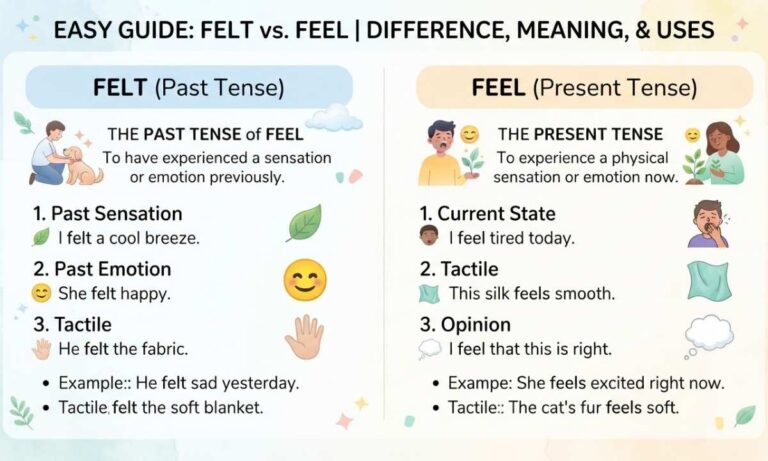
Felt vs feel trips up a lot of learners, but the fix is quick. “Feel” is present tense. “Felt” is past tense.
Both come from the same irregular verb. Only the time changes.
In this guide, you’ll get clear meanings, simple rules, and plenty of examples. By the end, you’ll know which one to pick.
What Does Feel Mean?
“Feel” is a verb for what you sense or think right now. It covers emotions, touch, and opinions.
Simple Meaning of Feel
- To experience an emotion, like joy or worry
- To notice something through touch
- To hold an opinion or belief
Examples of Feel
- I feel calm this morning.
- The blanket feels soft.
- I feel that we should wait.
What Does Felt Mean?
“Felt” is what “feel” turns into once the moment has passed. It’s both the past tense and the past participle.
Simple Meaning of Felt
- An emotion you had earlier
- A physical sensation from the past
- An opinion you held before
Examples of Felt
- I felt nervous before the exam.
- She felt a sharp pain in her leg.
- We felt that the plan was risky.
Felt Sense vs Feeling
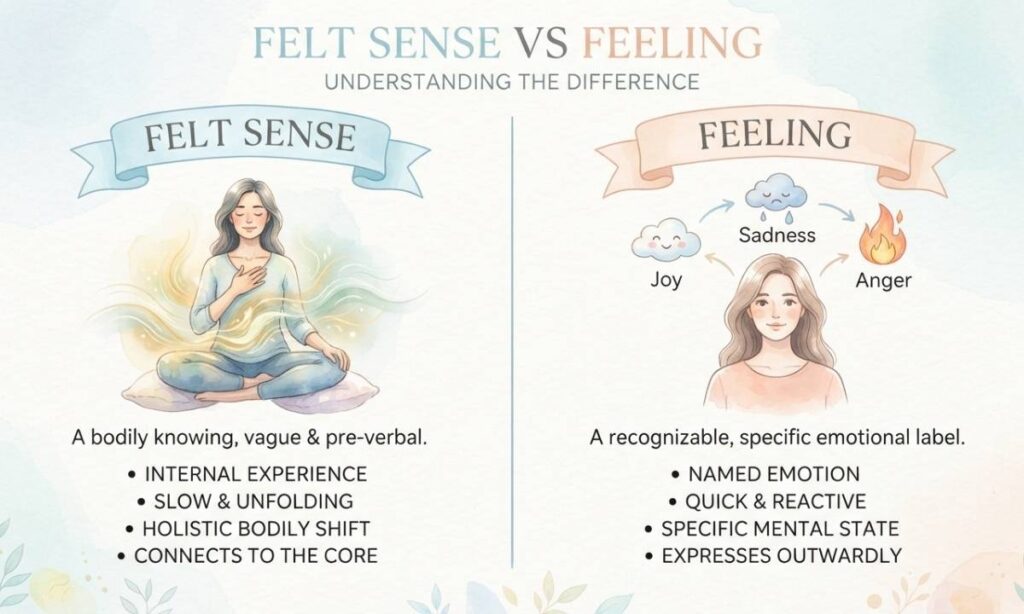
“Felt sense” is a term from psychology. It describes a vague body awareness you can’t explain yet, like a knot in your stomach before bad news.
A feeling is clearer. You can name it: anger, joy, or fear.
Here, “felt” works as an adjective, not as a past tense verb.
Key Difference Between Felt and Feel
| Word | Tense | Used For | Example |
| Feel | Present | Current emotions, sensations, opinions | I feel happy. |
| Felt | Past | Finished emotions, sensations, opinions | I felt happy. |
Simple Rule
Ask yourself one question: is it happening now?
- Yes: feel
- No, it’s over: felt
When to Use Feel
Reach for “feel” when you talk about the present, your habits, or general truths.
Remember the “s.” With he, she, or it, the word becomes “feels.”
Examples of Using Feel
- I feel better today.
- They feel proud of their team.
- She feels shy around crowds.
When to Use Felt
Choose “felt” once the moment is over. Time clues like yesterday, last week, or earlier are your best hints.
Good news: “felt” never changes. It stays the same for every subject.
Examples of Using Felt
- He felt dizzy yesterday.
- We felt relieved after the results.
- I felt cold all night.
Felt vs Feel in Sentences
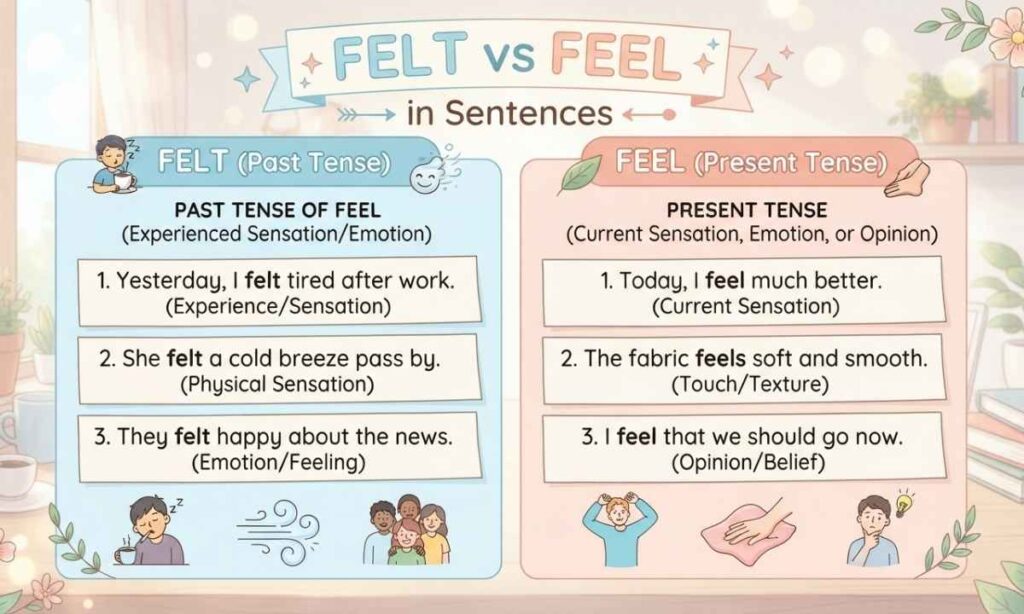
| Present (Feel) | Past (Felt) |
| I feel hungry. | I felt hungry at noon. |
| She feels tired. | She felt tired after class. |
| We feel excited. | We felt excited before the trip. |
Grammar Rules for Felt and Feel
Here are the forms at a glance:
- Feel is the base form and the present simple.
- Feels goes with he, she, and it.
- Felt is the simple past and the past participle.
- Feeling is the -ing form.
This verb is irregular, so you can’t add “ed.” Saying “feeled” is a common mistake.
Use “felt” after have, has, or had. For example: “I have felt this way before.”
Felt vs Feel in Questions
Questions need a helper verb like do, does, or did. After that helper, the main verb goes back to its base form.
- How do you feel today?
- Does she feel safe here?
- Did you feel any pain?
The last one catches many people. Say “Did you feel,” never “Did you felt.”
Felt vs Feel in Negative Sentences
Negatives work the same way. The helper verb carries the tense, and “feel” stays simple.
- I do not feel well.
- He does not feel ready.
- We did not feel worried.
“Felt” shows up in a negative only when there’s no helper. For example: “I never felt so alone.”
Felt vs Feel in Continuous Tense
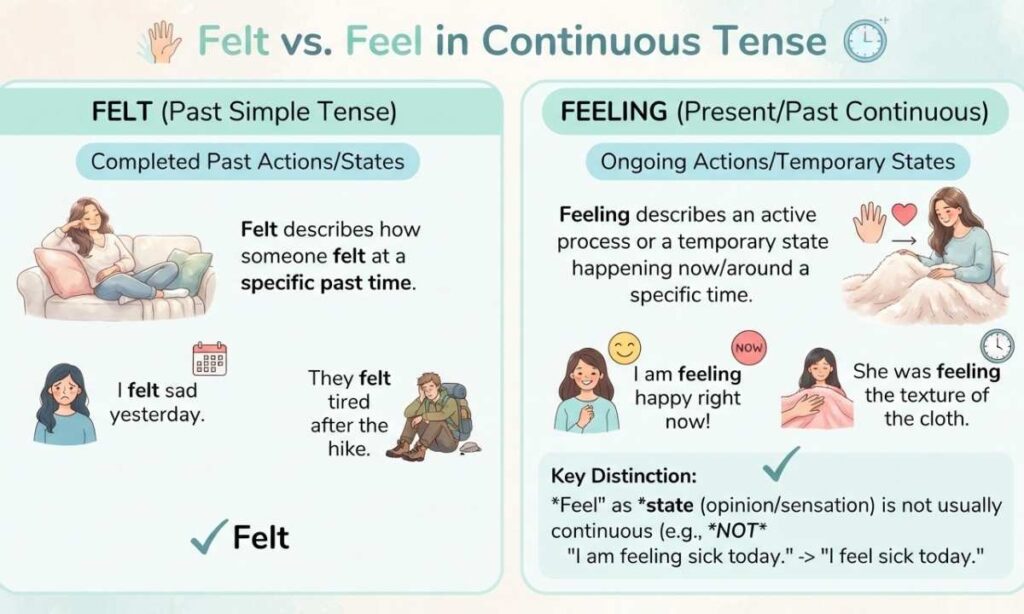
“Feel” is a state verb, and state verbs usually avoid continuous forms. But this one bends the rule.
Both of these are correct:
- I feel tired.
- I am feeling tired.
The second sounds more temporary, as if the mood may pass soon.
For the past, try “was feeling.” For example: “I was feeling dizzy.”
Felt vs Feel in Formal and Informal English
Both words fit any setting. The tone comes from the words around them.
Formal English
- I feel that the proposal needs revision.
- The committee felt the results were reliable.
Informal English
- I feel awesome today.
- I felt so lost at that party.
Felt vs Feel in Writing and Speaking
Tense mistakes stand out in writing. They can make an email or essay look careless.
In speech, people forgive slips more easily. Still, the right tense keeps your timeline clear.
Before you hit send, give your sentence one quick check. It takes five seconds.
Felt vs Feel with “That” Clauses
We often use “that” to share a belief or opinion. The first verb tells us when the opinion was held.
- I feel that this is fair.
- She feels that the plan will work.
- I felt that he was right.
- They felt that the rule was unfair.
In casual talk, you can drop “that.” “I feel it’s a good idea” sounds perfectly fine.
Felt vs Feel in Real-Life Conversations
Native speakers switch between these words without thinking. The time of the story decides the word.
- “I feel so much better now.”
- “I felt awful last night.”
Small talk is full of these forms. Getting them right makes you sound natural.
Felt vs Feel in Emotional Expression
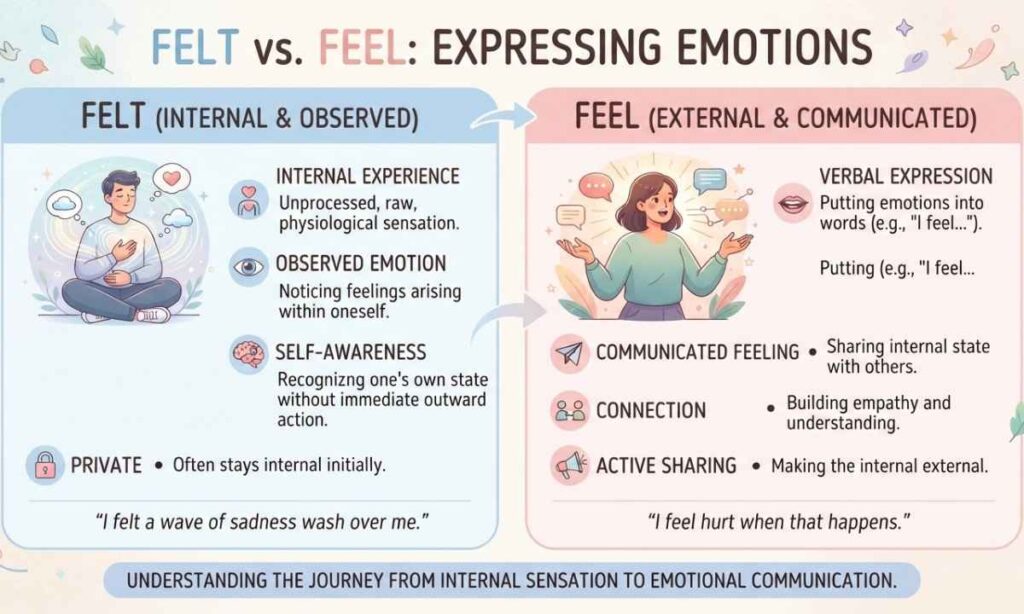
Emotions are where this verb works hardest. Both words pair with adjectives like happy, sad, angry, or anxious.
“Feel” shows how you are right now. “Felt” shows how you were.
- I feel grateful for your help.
- I felt grateful for your help.
The tense also tells your listener whether the emotion is still active.
Felt vs Feel in Storytelling
Most stories are told in the past, so “felt” appears a lot in narration.
- She felt her heart race as the door creaked open.
“Feel” fits dialogue. A character might whisper, “I feel like something is wrong.”
Stay consistent inside one scene. Jumping between tenses can confuse your reader.
Why Felt vs Feel Is Important
This small choice shapes how clear your message is. A wrong tense can even change the meaning.
- It strengthens your grammar.
- It keeps your timeline clear.
- It builds confidence when you write or speak.
- It cuts down on common errors.
Examples in Daily Life
Here are quick lines you might use any day.
Present Tense Examples
- I feel sleepy.
- Do you feel okay?
- The floor feels wet.
Past Tense Examples
- I felt sleepy after lunch.
- Did you feel the earthquake?
- The floor felt wet.
Similar Words to Feel
| Word | Meaning |
| Sense | To notice through the body |
| Experience | To go through something |
| Notice | To become aware of |
| Perceive | To detect or understand |
| Think | To hold an opinion |
These aren’t perfect swaps. “Feel” sounds warmer and more personal.
Felt as a Noun (Different Meaning)
“Felt” is also a noun. It means a soft fabric made by pressing wool or other fibers together.
- She made a hat from felt.
- The craft table had sheets of colored felt.
Context tells you which meaning is in play. If a material is being discussed, it’s the noun.
Tips to Remember Felt vs Feel
- Think feel = now and felt finished.
- Hunt for time clues like yesterday or last year.
- Don’t mix up “feel” and “fell.” “Fell” is the past tense of “fall.”
- Read your sentence aloud. Your ear often catches the wrong tense.
- Check for a helper verb. After did, always use “feel.”
Common Expressions with Feel and Felt
Many everyday phrases use these words. Learning them helps you sound natural.
Common Expressions with Feel
- Feel free: You’re welcome to do it. Feel free to ask questions.
- Feel better: To recover or calm down. I hope you feel better soon.
- Feel at home: To be comfortable. Our guests feel at home here.
- Feel like doing something: To want to do it. I feel like taking a walk.
Common Expressions with Felt
- Felt sorry for someone: Had sympathy. I felt sorry for him.
- Felt out of place: Didn’t fit in. She felt out of place at the dinner.
- Felt on top of the world: Was very happy. He felt on top of the world.
- Felt like giving up: Wanted to quit. I felt like giving up.
Frequently Asked Questions
What is the difference between Felt vs Feel?
“Feel” is the present tense. “Felt” is the past tense and past participle.
Can I use felt for the present?
No. Use “feel” or “feels” for the present.
What is the past tense of feel?
The past tense of “feel” is “felt.”
Is “felt” ever a noun?
Yes. As a noun, it means a soft fabric made from pressed fibers.
Is “I am feeling” correct?
Yes. It’s common and often describes a temporary mood.
Why do learners confuse these words?
They share one root verb, and the spelling changes only slightly.
Conclusion
Felt vs feel comes down to one idea: time. Use “feel” for now and “felt” for then.
Also remember that “felt” is a past participle and a noun too. A little daily practice will lock it in.
Soon you’ll pick the right word without thinking. Your writing and speaking will sound clearer and more confident.
2 thoughts on “Felt vs Feel Difference, Meaning, and Uses, Easy Guide”