
Wallahi meaning is simple on paper: it translates to “I swear by God.” But the way people use it today is far from simple. One short word can carry a lot of weight.
You may hear it in a mosque, a group chat, or a TikTok comment section. One person treats it as a sacred oath. Another uses it as a casual “for real.” That gap causes plenty of mixed signals.
This guide explains where the word comes from, how people use it, and when to skip it. Let’s clear up the confusion so you can use it with respect and confidence.
Wallahi Meaning at a Glance
Wallahi is an Arabic phrase that means “I swear by God.” People say it to show that they are telling the truth.
- Literal meaning: “By God” or “I swear by God”
- Language: Arabic
- Origin: Islamic oath language
- Modern use: “For real,” “I’m serious,” or “trust me”
- Strength: Very strong
- Sounds like: wal-LAH-hee
Simple definition: Wallahi is a phrase used to strongly confirm that something is true.
Origin & Background
Knowing the history makes the wallahi meaning much easier to understand. Here is how the word was built and how it travelled.
Linguistic roots
Wallahi has two parts. “Wa” is an Arabic particle used in oaths. It means “by.” “Allah” is the Arabic word for God.
The final “-i” is a grammar marker. Arabic changes the noun’s ending after an oath particle. That is why people say “Allahi” and not “Allah.”
Shorter forms exist too. “Wallah” is the most common one. “Billahi” is a close cousin that uses “bi,” another Arabic word for “by.”
Religious background
In Islam, an oath is a serious act. Swearing by God calls Him as a witness to your words.
Scholars describe different kinds of oaths. A deliberate promise about the future is binding. Breaking it requires expiation, as described in the Quran (5:89).
A careless slip, like “no, wallahi” in mid-sentence, is treated differently. The Quran (2:225) says God does not hold people accountable for thoughtless oaths. A knowingly false oath, however, is a grave sin.
Many Muslims also teach restraint. A truthful person should not need to swear all the time.
Cultural evolution
Migration carried the word far beyond the Arab world. Families brought it to Europe, North America, and many other places.
Then music and media took over. Urban scenes like hip-hop, grime, and drill introduced it to new listeners. Short videos did the rest.
Along the way, the wallahi meaning shifted for many speakers. It stayed sacred for some. For others, it became a lively intensifier.
Wallahi Meaning in Islam
The wallahi meaning in Islam is a direct oath by Allah. It is used to confirm a fact, promise an action, or show firm intent.
Because God is named as a witness, the speaker must be truthful. Most scholars advise saving the oath for serious matters.
If someone breaks a binding oath, they owe expiation. That can mean feeding ten poor people or clothing them. If they cannot afford that, they fast for three days.
Wallahi Meaning TikTok
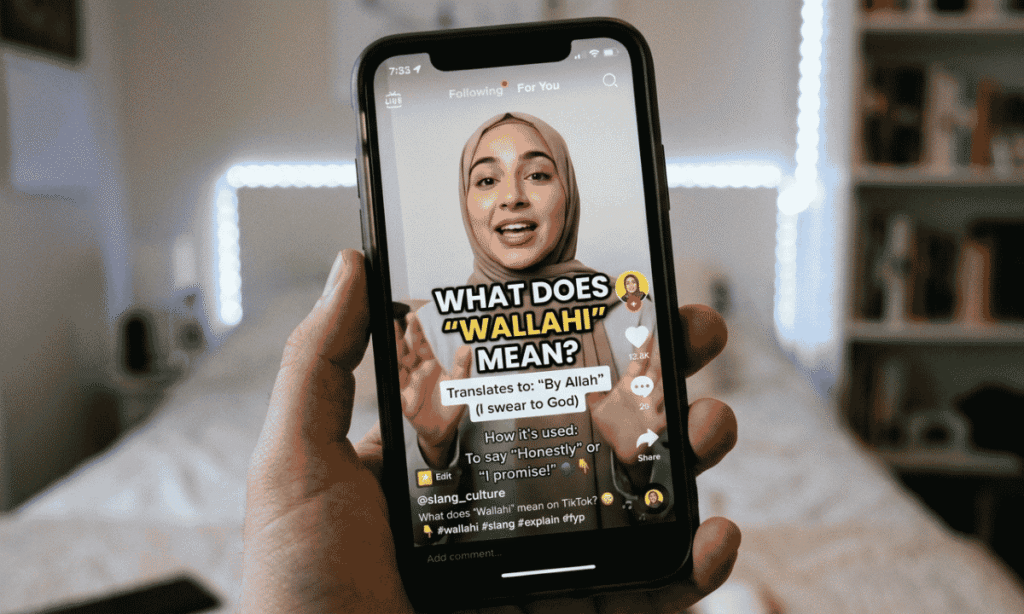
On TikTok, the phrase works as emphasis, not as a formal oath. Creators drop it into captions, skits, and replies.
You will often see “wallahi I’m done” to show exhaustion. You will also see “say wallahi” as a playful dare.
Most viewers read the tone as “I’m serious” or “this is real.” The mood is light, and nobody expects a religious vow.
Wallahi Meaning Gen Z

Gen Z uses wallahi the way it uses “deadass,” “no cap,” or “fr.” It stresses honesty, shock, or humor.
Some Gen Z speakers grew up saying it at home. Others picked it up from friends, music, or their feeds.
That mix keeps the wallahi meaning flexible for this generation. It can be sincere in one chat and a joke in the next. Still, many young Muslims dislike seeing it turned into a punchline.
Wallahi Meaning: Is It Offensive?

The word itself is not offensive. It is a normal Arabic phrase.
Offence comes from how it is used. Mocking it, using it to lie, or joking about it around people who hold it sacred can feel disrespectful.
A simple rule helps. If you are unsure how the listener feels, stay serious or skip it.
Wallahi Meaning: Is It Muslim?
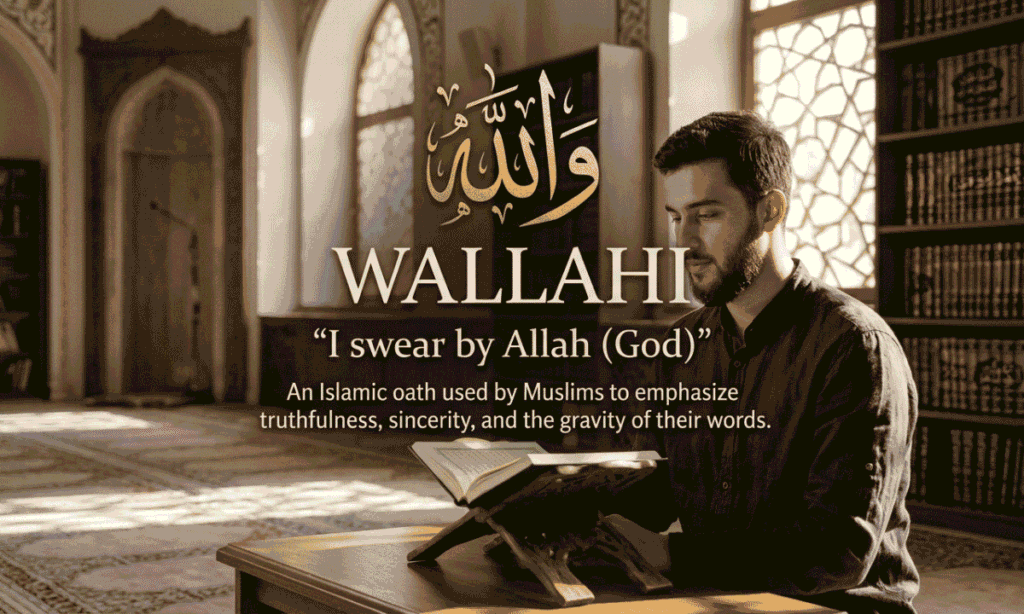
Many people ask whether wallahi is only for Muslims. It is not a “Muslim word” in the identity sense. It is an Arabic phrase with Islamic roots.
Muslims use it as a religious oath. Some Arabic-speaking Christians also say “wallah” in daily speech.
Non-Muslims can say it too. Just understand the weight behind it, and avoid using it as a joke.
Say Wallahi Meaning: What About “Speed”?
“Say wallahi” is a challenge. One person doubts a claim. The other person demands, “Say wallahi.”
If you say it, you are proving that you are honest. If you hesitate, people assume you were joking or lying.
Some searchers add “speed” after seeing viral streaming clips with this challenge. The extra word does not change the meaning. It has nothing to do with how fast you speak.
Real Life Conversations (Mandatory Examples)
These chats show the wallahi meaning in action. Notice how tone changes the message.
WhatsApp Chat
Sara: Did you really cook all of this yourself?
Bilal: Wallahi, nobody helped me.
Meaning: A sincere promise that he is telling the truth.
Instagram DM
Ayaan: That concert clip looks edited.
Zain: Wallahi it’s real. I was standing right there.
Meaning: Defending a claim with strong feeling.
TikTok Comments
User 1: No way this pizza is that good.
User 2: Wallahi, it’s the best I’ve had.
User 3: Say wallahi 😂
Meaning: Playful exaggeration and a friendly dare.
Emotional & Psychological Meaning
The emotional wallahi meaning is all about trust. People rarely say it at random. They say it when they want to be believed.
Why people connect with it
- It signals honesty in one quick word.
- It carries faith, family, and heritage.
- It adds weight when plain words feel too weak.
- It creates a sense of shared language and identity.
For many speakers, the word feels like home. It brings a familiar voice into a new setting.
Psychological intent
When someone says wallahi, the hidden message is often one of these:
- “Please believe me.”
- “I feel doubted.”
- “This matters to me.”
- “I’m not lying.”
Sometimes it is just habit. Heavy users may not think about the oath at all.
Reading the intent helps you respond with kindness instead of suspicion.
Usage in Different Contexts
Context shapes wallahi meaning more than any dictionary can. The same word can sound warm, funny, or heavy.
Social Media
Online, it is mostly emphasis. Example: “Wallahi, this song is addictive.”
Keep it light. Avoid attaching it to rumors or false claims. An oath next to misinformation looks bad and can offend readers.
Friends & Relationships
Among friends, it shows emotional honesty. Example: “Wallahi, I would never lie to you.”
It can calm an argument or express loyalty. But overuse backfires. If every sentence needs an oath, people start to doubt the speaker.
Work or Professional Settings
In general, avoid it at work. It can sound too informal, and it may feel too religious for a mixed team.
There is one exception. A relaxed team with a shared cultural background may use it in friendly chat. Never use it in legal, HR, or client conversations.
Casual vs Serious Tone
| Tone | Example | What it means |
| Casual | “Wallahi, this coffee is great.” | Strong praise |
| Playful | “Say wallahi!” | A friendly dare |
| Serious | “Wallahi, I did not take it.” | Defending integrity |
| Formal | “Wallahi, I will return it tomorrow.” | A binding promise |
Tone changes the message completely. Listen to the voice, not just the word.
Common Misunderstandings
Many people get wallahi meaning wrong. Here are the biggest myths.
1. “It’s just slang”
Not always. It became slang online, but it began as a religious oath. For many people, it still carries that seriousness.
2. “Anyone can say it freely”
Technically, yes. Nobody checks. But culturally, careless use can feel disrespectful, especially when it mocks the faith behind it.
3. “It always means the same thing”
No. Tone, setting, and speaker intent all matter. A friend’s joke and a courtroom promise are very different.
When NOT to use it
- As a joke about serious or painful topics
- When you are lying or exaggerating on purpose
- In professional, legal, or formal settings
- Around people who may feel hurt by casual use
- If you do not understand its weight
Comparison Table
This table shows how wallahi meaning compares with similar words.
| Term | Meaning | Strength | Best use |
| Wallahi | I swear by God | Very strong | Sincere statements |
| Billahi | By God | Very strong | Formal or religious speech |
| I swear | Plain English oath | Medium | General conversation |
| For real / fr | Truly | Mild | Casual chat |
| Honestly | Truthful tone | Mild | Everyday talk |
| Trust me | Asking for belief | Mild | Persuasion |
| Inshallah | If God wills | Not an oath | Future plans |
Key insight: Wallahi carries moral and cultural weight that most English phrases lack.
Variations / Types of Wallahi (Common Uses)
Most variations keep the same wallahi meaning. Only the tone changes.
- Wallah: The short, everyday form.
- Wallahi bro: Friendly reassurance between friends.
- Wallahi I swear: Double emphasis, often used in disbelief.
- Wallahi billahi: A very strong, repeated oath.
- Wallahi al azim: A formal oath meaning “by God the Magnificent.”
- Wallahi no joke: Stresses that the speaker is serious.
- Wallahi for real: Modern internet emphasis.
- Wallahi I didn’t know: Defensive sincerity.
- Wallahi I’m done: Meme-style exhaustion or frustration.
How to Respond When Someone Uses It
Your reply should match the wallahi meaning the speaker intended. First, decide whether the tone was serious or playful.
Casual replies
- “Okay, I believe you.”
- “Fair enough.”
- “Got it.”
Funny replies
- “Alright, court is adjourned.”
- “Say less.”
- “Wallahi? Now I’m scared.”
Use these only with friends who share your sense of humor.
Mature / confident replies
- “Thanks for being honest.”
- “I respect that.”
- “Let’s sort it out calmly.”
Private or respectful replies
- “I appreciate you telling me.”
- “I trust your word.”
- “You don’t need to swear. I believe you.”
The last reply is especially kind when someone seems anxious about being doubted.
Regional & Cultural Usage
Wallahi meaning also changes by region. The word travels well, but the feeling around it does not.
Western Culture
In the West, wallahi often shows up as youth slang. It spreads through music, schools, and social apps.
Many speakers use it without religious intent. Muslim communities, however, often still treat it with care.
Asian Culture
In South and Southeast Asia, it is mainly heard among Muslim communities. It keeps a strong religious tone there.
Urdu speakers often use equal phrases like “Allah ki qasam” or “khuda ki qasam.” The idea is the same: swearing by God.
Middle Eastern Culture
In the Arab world, “wallah” and “wallahi” are part of daily speech. They appear in markets, homes, and jokes.
Even so, overuse is often frowned upon. Some elders see constant swearing as a lack of restraint.
Global Internet Usage
Online, wallahi is meme material. It appears in captions, reaction videos, and comment threads.
The meaning becomes lighter but stays recognizable. Emojis and tags like “fr” help show the speaker’s tone.
Frequently Asked Questions
What is the wallahi meaning in English?
It means “I swear by God” or “by God.” People use it to stress that they are telling the truth.
Is it a sin to say wallahi?
Saying it truthfully is not a sin. Swearing falsely on purpose is a serious sin in Islam.
Can non-Muslims say wallahi?
Yes, they can. They should understand its religious weight and avoid using it jokingly.
What is the difference between wallah and wallahi?
Both carry the same meaning. “Wallah” is simply the shorter, more casual form.
Is wallahi the same as inshallah?
No. Wallahi swears that something is true. Inshallah means “if God wills” and refers to future plans.
Why do people say wallahi so often?
To sound sincere, win trust, or express strong feeling. For some people, it is also just habit.
Conclusion
Wallahi meaning goes far beyond a simple translation. At its core, it stands for truth, emotion, and sincerity.
Modern slang has softened the word for many speakers. Yet for many others, it still feels deeply sacred.
The best approach is easy. Learn the roots, read the tone, and respect the listener. Use it thoughtfully, respond to it kindly, and remember why people reach for it when plain words are not enough.
2 thoughts on “Wallahi Meaning: Best Guide to Its Real Meaning and Usage”