
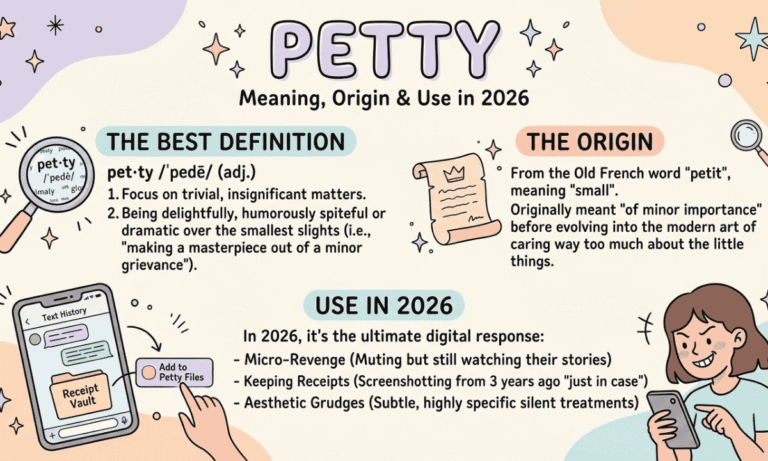
Petty meaning looks simple on paper, but it shifts with tone and context. The word describes someone who spends too much energy on small, unimportant things. One “that’s so petty” can sound like a joke, a jab, or a real insult.
You hear it in group chats, TikTok comments, and office hallways. Who says it, and how, matters as much as the word itself. A smile turns it into teasing. A cold tone turns it into an attack.
This guide covers the definition, origin, slang use, and psychology behind the word. You will also find real chat examples, a comparison table, and replies you can use right away.
Petty Meaning: Quick Meaning
Petty describes behavior that fixates on small issues in a negative or childish way. Dictionaries also list “of little importance” and “small-minded.” That is the core petty meaning in one line.
Quick facts:
- Part of speech: Adjective
- Core idea: Making a big deal out of something small
- Usual tone: Critical, but sometimes playful
- Common pairings: petty argument, petty revenge, petty complaint, petty drama
Short examples:
- “Sending that screenshot just to prove a point was petty.”
- “It was a tiny mistake. There’s no need to be petty about it.”
- “Yes, I’m petty. I still want my charger back.”
Origin & Background of the Word “Petty”
Petty comes from the Old French word petit, which means “small.” It entered English in the late 14th century as peti. At first, it simply meant small or minor. It carried no insult.
That older sense still survives. Petty cash means small sums of money. A petty officer is a lower-ranking officer. Petty theft is a minor crime.
According to the Online Etymology Dictionary, the sense of “not serious or of small importance” appears in the 1520s. The sense of “small-minded” shows up in the 1580s. That timeline shapes the modern petty meaning.
Here is how the word grew:
- Late 1300s: Small, little, or minor
- 1520s: Unimportant or not serious
- 1580s: Small-minded
- Today: Spiteful, oversensitive, or playfully self-aware
That shift explains why the word now describes attitude, not size.
Cultural & Internet Influence
Social media gave the word a second life. Online, petty now points to passive-aggressive moves, subtle revenge, and silent competition. Unfollowing someone after a fight is a classic example.
Memes and viral posts made the label feel almost fun. People now say “petty but honest” or “petty with a purpose.” Some even wear it like a badge.
Still, the internet did not erase the sting. The petty meaning online depends on who says it and who hears it. A close friend may laugh it off. A stranger may take offense.
Petty meaning synonyms
Several words overlap with petty. None is a perfect swap, but they help you find the right shade.
- Small-minded: Focused on narrow, unimportant concerns
- Trivial or trifling: Of little value (describes things, not people)
- Nitpicky: Obsessed with tiny flaws
- Mean-spirited: Unkind on purpose
- Spiteful: Wanting to hurt or get even
- Childish: Acting in an immature way
- Fussy or picky: Too concerned with small details
Opposites: generous, forgiving, big-hearted, easygoing, and mature.
Pick the synonym that matches the situation. “Spiteful” is much stronger than “picky.”
Petty meaning slang
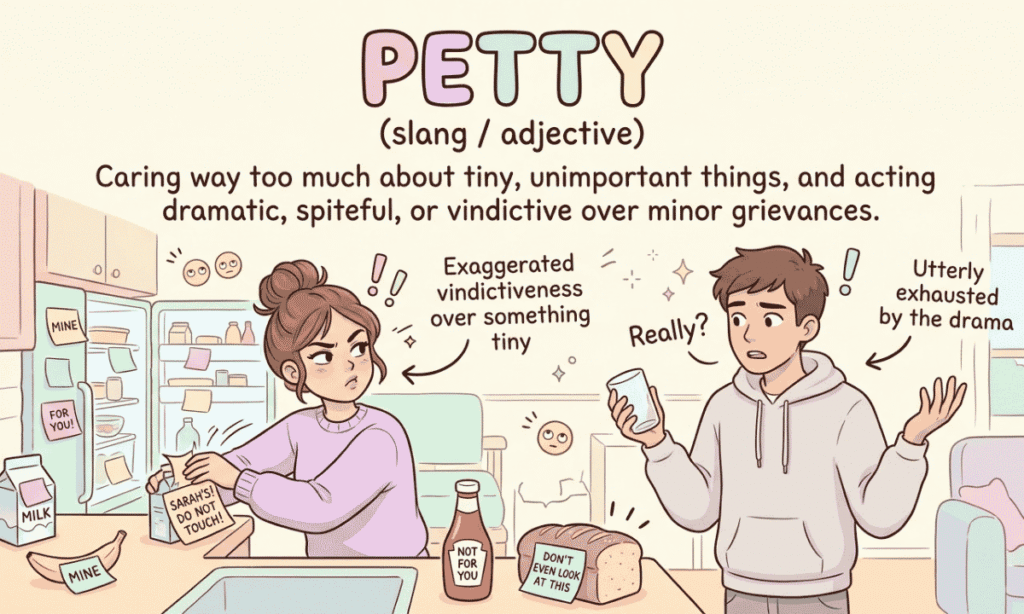
In slang, petty describes small, spiteful, or ego-driven actions. It often comes with a wink. People use it for things like leaving a message on read or posting a vague quote after an argument.
Common slang phrases:
- Petty king / petty queen: Someone who owns their pettiness
- Petty Betty: A playful name for a petty woman
- Petty but honest: Admitting the behavior without shame
- Extra petty: Taking pettiness up a level
- Petty with a purpose: A small action with a clear point
Fun fact: Green’s Dictionary of Slang records an old, rare use of petty as a term of endearment. Today’s slang runs the other way.
Petty behavior meaning

Petty behavior means acting on small grievances in a way that does not match the problem. The reaction is bigger than the issue. That gap is the key.
Common examples:
- Giving the silent treatment over a minor comment
- Keeping score of who texted first
- Paying backhanded compliments
- Correcting tiny errors just to feel superior
- Bringing up old arguments during new ones
- Replying slowly on purpose
Petty behavior is not always loud. It is often quiet, indirect, and passive-aggressive.
Petty person meaning
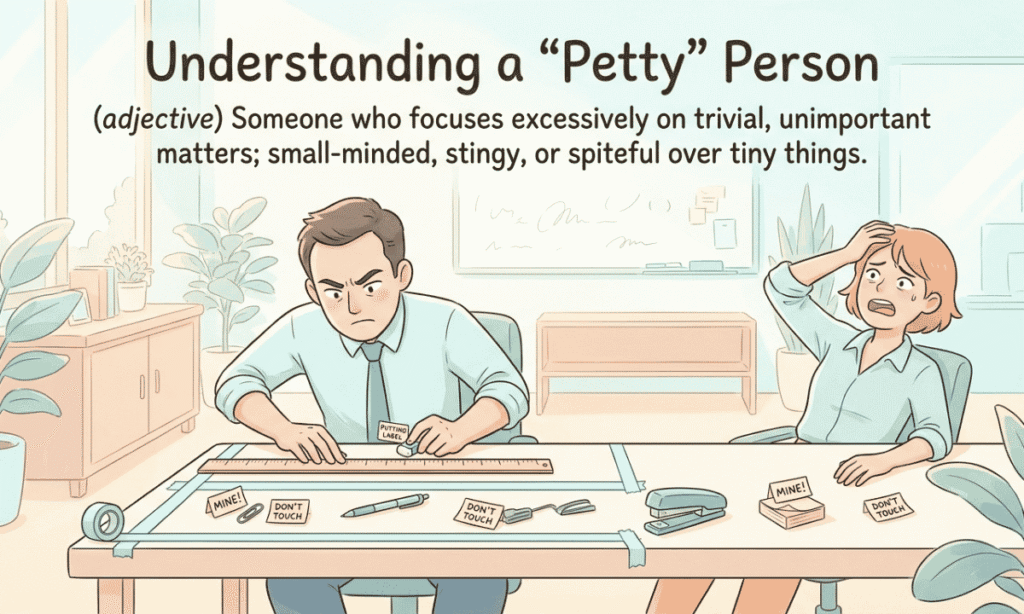
A petty person is someone who often reacts to small things with grudges, sarcasm, or score-keeping. The word points to a pattern, not a single moment.
Typical traits:
- Struggles to let go of minor slights
- Hates admitting fault
- Judges small choices harshly
- Avoids direct conversation
- Leaves others out as a quiet punishment
Be careful with this label, though. Almost everyone has petty moments. Calling someone “a petty person” is harsher than calling one act petty.
Real Life Conversations (How People Actually Use “Petty”)
Real chats show how flexible the word is. The same word can sound playful, defensive, or critical. Here are three examples.
WhatsApp Chat
- Sana: You muted the family group again?
- Ali: Yes. Uncle corrected my spelling in front of everyone.
- Sana: That’s petty.
- Ali: Maybe. But I’m petty and at peace.
Here, “petty” is gentle and self-aware. Ali owns it with humor.
Instagram DMs
- Zara: You posted a “some people never change” story right after our fight?
- Hina: It was vague.
- Zara: It had our song on it. Very petty.
- Hina: Okay, okay. Deleting it. 😅
Here, petty works as a mild call-out between close friends.
TikTok Comments
- @dailyvibes: She returned his hoodie after three years with a sticky note 😭
- @nora.k: Petty? Yes. Iconic? Also yes.
- @mike_r: Not iconic. Just petty.
The crowd splits here. Online, petty can earn praise and criticism in the same thread.
Emotional & Psychological Meaning of “Petty”
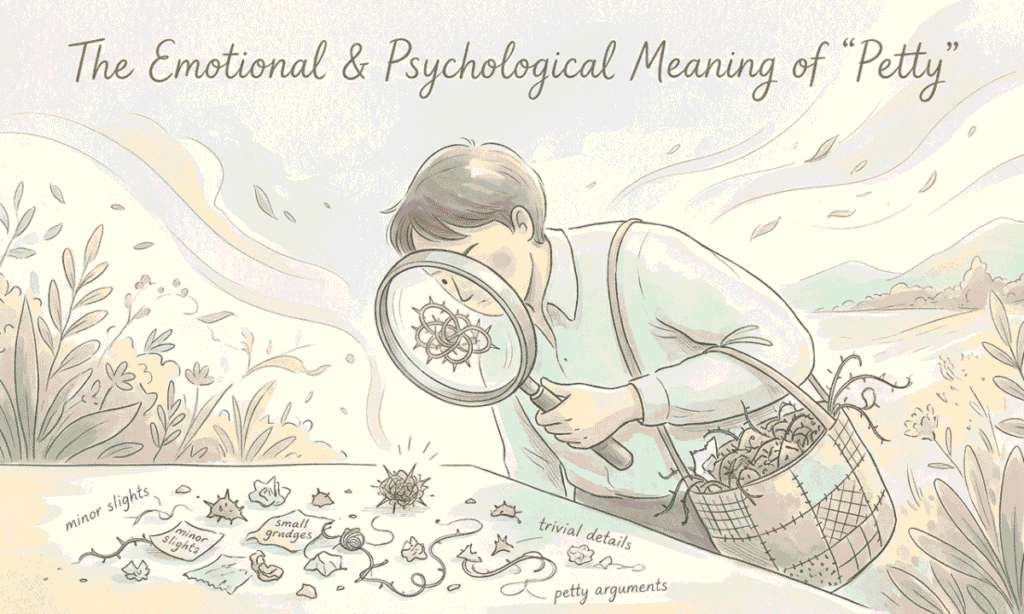
Petty behavior usually comes from emotion, not logic. People act petty when they feel ignored, disrespected, insecure, or powerless.
A small act can feel safer than a hard talk. Muting someone is easier than saying “you hurt me.” In that way, pettiness often works as a defense mechanism.
Psychologists often describe it as a disproportionate emotional response. The trigger is small. The feeling behind it is not.
Industrial-organizational psychologist Alex Alonso studied this at work. According to a summary of his research, he polled 15,000 HR professionals and sorted petty acts by intensity and severity.
Ask yourself these questions when you feel petty:
- What am I really upset about?
- Will this matter in a week?
- Can I say it directly instead?
Pettiness is a signal. It points to a need that has not been spoken.
Usage in Different Contexts
The petty meaning changes with the setting. A word that works in a meme can backfire in a meeting.
On Social Media
- Often used with humor or sarcasm
- Frequently self-labeled, like “petty but honest”
- Can attract likes, shares, and quick validation
- Can also fuel public drama
On social media, the petty meaning is often a performance. The audience shapes how it lands.
Among Friends & Relationships
Between close friends, petty can be playful teasing. It says, “I see what you did.”
In romantic relationships, it can escalate fast. Keeping score, reopening old fights, or ignoring texts on purpose can build distance. Tone matters more than the word itself.
At Work or Professional Settings
At work, petty is almost always negative. It suggests immaturity and weak professionalism.
Typical examples include nitpicking a colleague’s formatting to embarrass them or leaving someone off an email thread on purpose.
According to a summary of SHRM’s 2019 pettiness survey, about 75% of respondents said petty offenders faced no official consequences. Ignored pettiness can erode trust and morale.
In formal writing, skip the word. Describe the behavior instead.
Casual vs Serious Use
- Casual: “That was petty, but funny.”
- Serious: “This level of pettiness is hurting the team.”
The petty meaning shifts with the stakes. Casual use invites a laugh. Serious use invites change.
Common Misunderstandings About “Petty”
Many people misread the petty meaning because tone hides the intent. Here are three common mix-ups.
Petty Means Angry
Not always. Petty behavior can be calm, quiet, and even polite. A delayed reply or a cold “k” can be petty without a raised voice.
Petty Is Always Harmless
Small acts add up. Repeated pettiness can damage trust, especially at work or in close relationships.
Light pettiness is mutual and low-stakes. Harmful pettiness is one-sided and aimed at causing discomfort.
Petty Equals Funny
Online, sometimes. In real life, often not. If the other person feels hurt, the joke has failed.
When NOT to Use It
Avoid the word in these moments:
- During professional conflict resolution
- When someone is genuinely hurt or grieving
- When the issue feels small to you but big to them
- When you want to dismiss a valid concern
The last point matters most. “You’re being petty” can shut down an honest complaint. Use it carefully.
Comparison Table: Petty vs Similar Terms
| Term | Meaning | How It Differs from Petty | Example |
| Petty | Overreacting to small issues | Focused on minor details and grudges | “Blocking him over a typo was petty.” |
| Immature | Lacking emotional growth | A broader, ongoing pattern | “He sulks every time he loses.” |
| Spiteful | Wanting to hurt on purpose | More aggressive and intentional | “She spread the rumor to hurt him.” |
| Trivial | Unimportant | Describes things, not people | “It’s a trivial detail.” |
| Nitpicky | Fixated on tiny flaws | About criticism, not revenge | “He nitpicked every comma.” |
| Forgiving (opposite) | Letting go of small issues | A calm, mature response | “She laughed it off and moved on.” |
Key insight: The petty meaning is not about the issue. It is about how much emotional energy someone gives it.
Variations / Types of Petty (Common in Real Life)
- Petty revenge: Small actions meant to “get back” at someone
- Silent petty: Ignoring messages or delaying replies on purpose
- Social media petty: Unfollowing, subtweeting, or posting indirect quotes
- Workplace petty: Correcting minor mistakes just to feel superior
- Relationship petty: Bringing up old arguments in new disagreements
- Self-aware petty: Admitting the behavior but continuing anyway
- Competitive petty: Trying to outdo someone over meaningless things
- Emotional petty: Driven by hurt feelings rather than logic
- Passive-aggressive petty: Using indirect actions instead of open talk
How to Respond When Someone Uses “Petty”
Your reply depends on whether the comment was a joke or a real critique. Use these lines as starting points.
Casual Replies
- “Maybe, but it’s not that deep.”
- “Fair. I was in my feelings.”
- “Okay, that one’s on me.”
Funny Replies
- “Petty with a purpose.”
- “Certified petty, unfortunately.”
- “I prefer the term detail-oriented.”
Mature & Confident Replies
- “You’re right. Let’s focus on what matters.”
- “I’ll handle that better next time.”
- “Fair point. Let me reset.”
Private or Respectful Replies
- “That wasn’t my intention. Thanks for telling me.”
- “I see how it came across. Can we talk?”
- “Let’s talk about this one-on-one.”
Regional & Cultural Usage
The petty meaning is widely understood, but how openly people use it varies. Age, family, and setting all play a role. These are broad patterns, not strict rules.
Western Culture
In English-speaking countries, petty is common in casual speech. It is often humorous, sarcastic, and self-labeled. You will spot it in memes, reality TV clips, and daily chats.
Asian Culture
In many Asian communities, group harmony and respect for elders shape how people speak. Direct labels like “petty” may feel blunt. Pettiness is often hinted at through silence, tone, or indirect remarks. Younger online users, however, often use the English word freely.
Middle Eastern Culture
Styles vary by country, family, and generation. In many settings, respect and family ties make people careful with harsh labels. Online, younger users often borrow English slang like “petty” and mix it with their own language.
Global Internet Usage
Social media made the word global. Users across regions understand it, often in a playful or ironic way. Memes, captions, and short videos keep spreading it, and each community adds its own twist.
Read More Moots Meaning In Text
Frequently Asked Questions
What is the petty meaning in simple words?
Petty means focusing too much on small, unimportant things, often in a spiteful or childish way.
What does petty mean in slang?
In slang, it describes small, spiteful acts like unfollowing, leaving someone on read, or subtweeting. It is often said with humor.
Is the petty meaning always negative?
Mostly, yes. It can be playful among friends, but it usually signals disapproval.
Is being petty always bad?
No. Light, occasional pettiness is human. Repeated pettiness can harm trust.
Can petty be a joke?
Yes, especially online or among close friends. Tone decides how it lands.
Is petty the same as immature?
Not exactly. Pettiness is situational, while immaturity is a wider, ongoing pattern.
Can you call yourself petty?
Yes. Many people do, usually with humor and a bit of honesty.
Is petty unprofessional at work?
In most workplaces, yes. It suggests poor judgment and can hurt teamwork.
What is the opposite of petty?
Forgiving, generous, understanding, or focused on the bigger picture.
Conclusion
The petty meaning goes far beyond “small” or “minor.” It started as a neutral word for size. Today, it describes how people handle emotion, conflict, and self worth.
Sometimes it is funny. Sometimes it is harmful. Often it is simply human.
Knowing the petty meaning helps you read social cues better. It helps you reply with more care. It also helps you spot your own triggers before they grow.
The next time pettiness shows up, pause and ask what really matters. That small question can save a friendship, a team, or your own peace of mind.
1 thought on “Petty Meaning: Best Definition, Origin & Social Media Use ”