
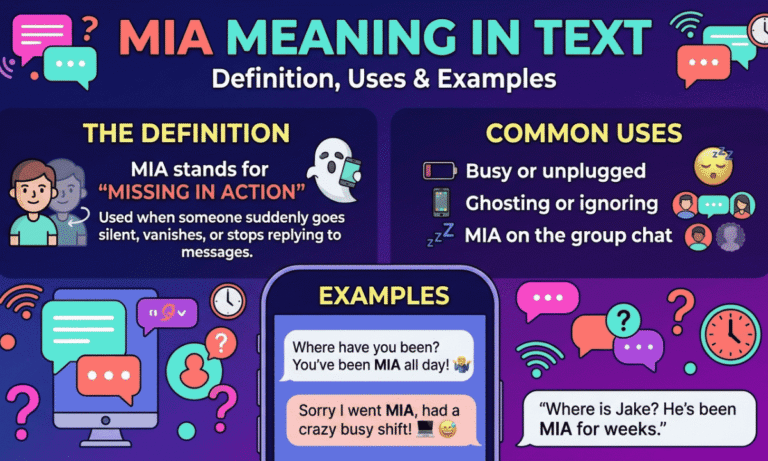
MIA meaning is simple: it stands for “missing in action.” In texting, it points to someone who has gone quiet, skipped plans, or vanished from a chat for a while. You’ve probably seen it the moment a friend stopped replying.
The phrase started in the military. Now it lives in group chats, DMs, and comment sections. People use it to tease a friend, flag a delay, or explain their own silence. Sometimes it’s a joke. Sometimes it’s a gentle nudge.
This guide explains the MIA meaning, its history, real examples, and the right moments to use it. By the end, you’ll know how to read it and how to reply.
What Does MIA Mean? (Spoiler: It’s Not Just for Soldiers)
MIA stands for “missing in action.” In texting, it means a person is absent, unreachable, or silent without a clear reason. That is the core MIA meaning in text.
The original sense is serious. A soldier is listed as MIA when his fate is unknown after a battle. Dictionaries still record that formal use.
The casual sense is lighter. It often just means, “I haven’t heard from you.”
People use it in a few common ways:
- Chat silence: someone stops replying for days.
- No shows: a friend skips plans without a word.
- Social media breaks: a creator stops posting.
- Work delays: a teammate goes quiet on a task.
MIA can also point to other things:
- Miami International Airport, whose airport code is MIA
- The Minneapolis Institute of Art, often called Mia
- The first name Mia, which means “mine” in Italian
Context tells you which MIA meaning applies. In a group chat, it means “missing in action.” On a flight booking, it means Miami.
From War Zones to WhatsApp: How MIA Went Viral?
The phrase started in the military. “Missing in action” described troops who couldn’t be found after fighting. Merriam-Webster traces the noun to 1944 and the adjective to 1946.
Later conflicts kept the term in the news. Families, reporters, and governments used it for years.
Then it slipped into everyday speech. Writers began saying someone “went MIA” for any kind of disappearance. Merriam-Webster even includes an example about a filmmaker who vanished from public view for five years.
Texting finished the job:
- SMS and instant messengers made short forms normal.
- Twitter and Facebook made public silence easy to spot.
- WhatsApp, Instagram, and TikTok added “last seen,” read receipts, and story views.
Absence became visible. People needed a quick, light word for it. MIA fit perfectly.
Real Life Text Examples
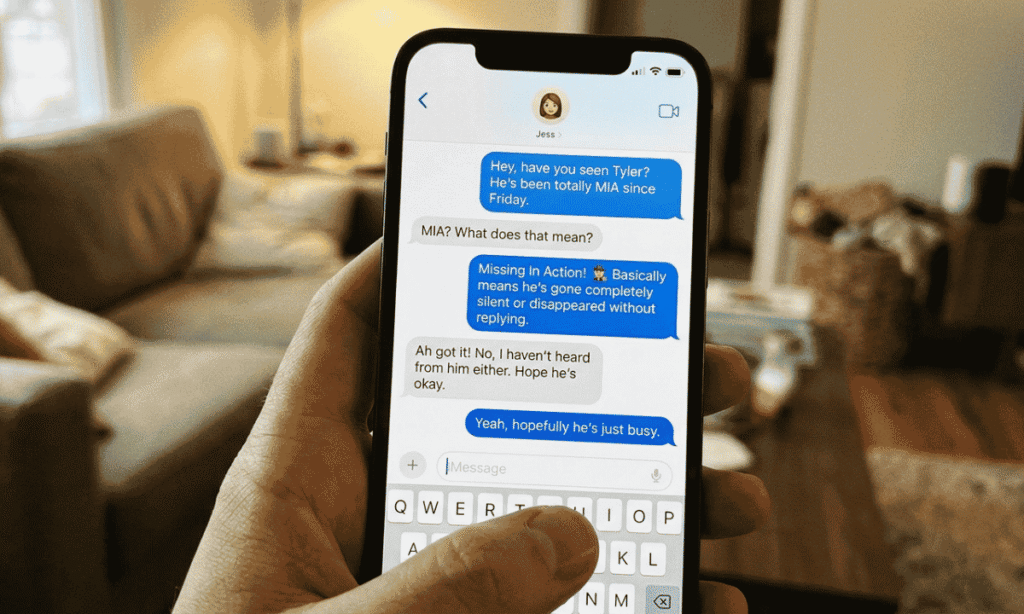
Seeing real lines makes the slang easier to grasp. Here are common examples:
| Situation | Example text | Tone |
| Friend group | “Where have you been? You’ve been MIA all week.” | Playful |
| After a date | “You went MIA after Saturday. Everything okay?” | Concerned |
| Your own excuse | “Sorry I was MIA, my phone died.” | Apologetic |
| Work chat | “I’ll be MIA from 2 to 4 for a client call.” | Neutral |
| Social media | “Been MIA from Instagram, but I’m back!” | Cheerful |
| Family group | “Dad’s been MIA since he got that new phone.” | Teasing |
Notice the pattern. Most lines use “been MIA” or “went MIA.”
Tone changes with delivery. An emoji softens the message. A bare period can sound sharp.
MIA vs. Ghosting vs. AFK: What’s the Difference?
These three terms get mixed up often. They are not the same.
| Term | Stands for | Meaning | Intent | Usually lasts |
| MIA | Missing in action | Absent or silent | Often unintentional | Days to weeks |
| Ghosting | No acronym | Cutting off all contact suddenly | Deliberate | Often permanent |
| AFK | Away from keyboard | Briefly away from a device | None, just a pause | Minutes to hours |
| AWOL | Absent without leave | Gone without permission | Varies | Varies |
Use this quick guide:
- MIA: “I haven’t heard from you lately.”
- Ghosting: “You chose to cut me off.”
- AFK: “I’m stepping away right now.”
The key difference in MIA meaning is intent. MIA describes a gap. Ghosting describes a decision. AFK describes a short, planned pause.
MIA Meaning Slang Katseye Connection
Pop fans often link MIA to music. KATSEYE, the global girl group from HYBE and Geffen Records, released a song titled “M.I.A.” on June 27, 2025. It appeared on their EP Beautiful Chaos.
The track plays with the slang idea. It centers on slipping away on your own terms and refusing to be controlled. Lyric sites describe it as a confident, detached pop song.
A music video followed in September 2025. Riot Games also reworked the song as the anthem for the VALORANT Game Changers Championship 2025.
Did the song change the MIA meaning? Not really. The slang is decades older. But the song gave it a bolder spin. Going MIA became a power move, not just a problem.
Don’t confuse it with the rapper M.I.A. That’s a different artist entirely.
MIA Meaning in Work

At work, MIA usually means someone is unreachable. It might be a coworker, a client, or a vendor.
Examples:
- “The client has been MIA since Monday.”
- “Sorry, I was MIA this morning. Back-to-back meetings.”
- “Our designer is MIA on this ticket.”
The MIA meaning at work stays the same, but the stakes feel higher. Calling a manager MIA can sound rude. Calling yourself MIA is fine in a casual team chat.
For formal messages, use clearer words:
- “I was unavailable.”
- “I’m out of office until Friday.”
- “I haven’t received a response yet.”
Clear wording protects your tone and your professional image.
MIA Urban Dictionary
Urban Dictionary is a crowd-sourced slang site. Anyone can submit a definition. That makes it great for current slang and weak for accuracy.
Entries on slang sites typically describe the MIA meaning as someone who vanished, stopped replying, or skipped out on plans. Many add jokes or personal stories. Some attach other meanings, like a name or a place.
Treat it as a snapshot of how people talk. It isn’t a final authority.
For a trusted definition, check a dictionary such as Merriam-Webster. Then use Urban Dictionary to understand tone and trends.
MIA Meaning in Relationship

In dating, MIA means a partner or crush has gone quiet. It often shows up after a date, a fight, or a few great weeks of texting.
Examples:
- “He went MIA after our second date.”
- “You’ve been MIA since the argument.”
The MIA meaning in a relationship carries emotion. It can signal worry, hurt, or confusion.
Often, the person is just busy, stressed, or overwhelmed. Sometimes they’re losing interest. You can’t tell from one silent weekend.
Don’t assume the worst. Ask directly and kindly.
Is MIA the same as ghosting in a relationship?
Not always. Ghosting is a deliberate, complete cut-off with no explanation. MIA can be temporary and unintentional.
A person who goes MIA may return with an apology and a reason. A ghost usually doesn’t.
Look at patterns. One quiet weekend is MIA. Weeks of silence after clear interest start to look like ghosting.
How to Respond When Someone Calls You MIA?
Someone called you MIA? Stay calm. It’s usually friendly.
Follow these steps:
- Acknowledge it. A quick “yeah, you’re right” works.
- Give a short reason. Busy, sick, traveling, or burnt out is enough.
- Keep your privacy. You don’t owe every detail.
- Reconnect. Ask how they’ve been.
- Set a plan. Suggest a call or a coffee.
Sample replies:
- Casual: “Haha, guilty. Work has been wild. What did I miss?”
- Apologetic: “Sorry I was MIA! Rough week. Can we catch up Sunday?”
- Boundary-setting: “I needed some space, but I’m back now.”
- Professional: “Apologies for the delay. Here’s the update you asked for.”
Knowing the MIA meaning helps you pick the right tone. A playful tease needs a light reply. A worried message needs a warmer one.
MIA Meaning in English
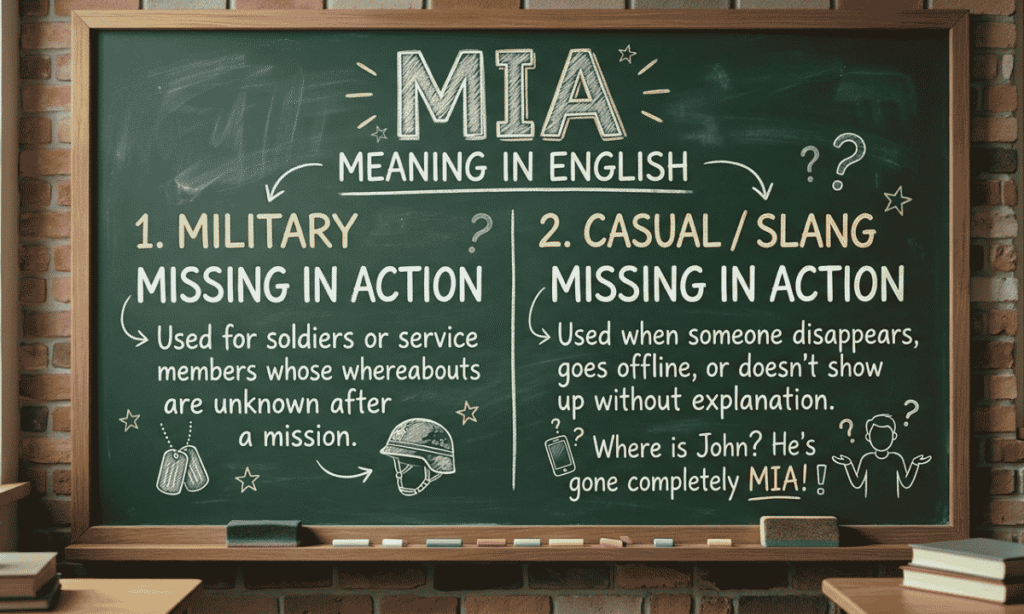
In standard English, MIA is an initialism. You say each letter: “em-eye-ay.”
It works as both an adjective and a noun:
- Adjective: “He’s been MIA lately.”
- Noun: “The report listed three MIAs.”
- Common verbs: be, been, go, went
The MIA meaning in English splits into two registers. The formal one covers military and official reports. The informal one covers everyday absence.
Writers usually capitalize it. In texts, you may see “mia” in lowercase. That’s fine in casual chats.
MIA Meaning in Chat
In chat apps, MIA is quick and casual. You’ll find it on WhatsApp, Discord, Slack, Messenger, and iMessage.
People often add emojis like 👀, 😂, or 🫠. They show the tone at a glance.
Typical chat uses:
- Calling out a silent friend in a group
- Warning others you’ll be offline
- Joking about your own disappearance
Example: “Gonna be MIA till Friday, exam week 😭.”
The MIA meaning in chat is almost always light. A short, friendly message beats a long explanation.
MIA Around the World (Not Everyone Uses It!)
English slang travels fast, but not every culture uses MIA. Many people, including English learners, pick it up online.
In places like Pakistan and India, young people often mix English slang with Urdu or Hindi. You may hear “MIA” and “gayab” in the same chat.
Other languages have their own ways to say someone disappeared:
| Language | Common phrase | Rough meaning |
| Spanish | “Andas desaparecido” | You’ve been missing lately |
| French | “Aux abonnés absents” | Unreachable |
| Italian | “Sei sparito” | You vanished |
| German | “Abgetaucht” | Gone underground, out of contact |
| Urdu/Hindi | “Gayab” | Vanished, not around |
The idea is universal. Only the wording changes.
Watch out for false friends too. In Italian, “mia” means “mine.” In Spanish, “mía” also means “mine.” So the MIA meaning depends on language as well as context.
MIA in 2024 : 2026: Why It’s Bigger Than Ever
MIA isn’t fading. If anything, people reach for it more often. A few reasons stand out:
- Always-on chats: Group chats never sleep, so silence stands out.
- Remote and hybrid work: Teams rely on messages, so a missing reply is noticeable.
- Digital detox culture: More people openly step away from social media.
- Mental health awareness: Going quiet is now often described as taking space.
- Pop culture: Songs like KATSEYE’s 2025 release keep the phrase in circulation.
The tone has shifted too. A few years ago, MIA sounded like a complaint. Now it often sounds like a mild joke, or even a boundary.
The MIA meaning has barely changed, but the attitude around it has. Expect the slang to stay. It’s short, flexible, and easy to understand. That’s the recipe for lasting internet language.
When NOT to Use MIA
MIA is casual. Skip it in these situations:
- Formal emails, cover letters, and reports
- Customer support or client updates
- Real missing-person cases or emergencies
- Messages about military families or loss
- Chats with people who may not know the slang, such as some older relatives
- Legal, medical, or official paperwork
Joking about a serious disappearance can hurt people. If someone is truly missing, say so plainly and contact the right authorities.
When unsure, write the full phrase: “missing in action.” Or choose “unavailable” or “unreachable.”
MIA Meaning on Instagram
On Instagram, MIA shows up in captions, stories, comments, and DMs.
Common uses:
- A creator returns after a break: “Been MIA, but I’m back.”
- A follower comments: “Where have you been? MIA much?”
- A friend DMs: “You’ve been MIA from my feed!”
Here, MIA mostly means inactive. It rarely signals anything serious.
Pair it with a photo, a Reel, or a story to explain the gap.
If you’re a creator, a short “I was MIA” post builds trust. Followers appreciate honesty.
MIA Meaning on TikTok
On TikTok, MIA mostly means inactive or absent. The exact tone depends on context. Sometimes the person was just busy. Other times they were ignoring messages.
Common examples:
- A creator posts a “back from MIA” video.
- Fans comment “you went MIA!” under a new upload.
- Friends tease each other in replies.
It works well with trending sounds, voiceovers, and short captions. Keep it playful.
If you’re posting after a long break, say why. Even one line makes you feel more real.
Frequently Asked Questions
What is the MIA meaning in text?
MIA means “missing in action.” In texts, it describes someone who is absent, silent, or unreachable.
Is the MIA meaning always negative?
No. It’s often playful, and it can even describe taking healthy space.
Is MIA the same as AWOL?
They’re close. AWOL means gone without permission, while MIA just means absent or unaccounted for.
Can I use MIA in a work email?
It’s best to avoid it. Use “unavailable” or “out of office” instead.
What does “went MIA” mean?
It means someone disappeared or stopped responding for a while.
Does MIA mean the same on TikTok and Instagram?
Yes. On both, it usually means inactive or not posting.
What does MIA mean in the KATSEYE song?
It plays on the slang idea of vanishing on your own terms.
Conclusion
MIA meaning is easy once you see the pattern. It started as a serious military term and became everyday slang for anyone who goes quiet.
Context, tone, and audience decide how it lands. Use it with friends, creators, and casual coworkers. Skip it in formal or sensitive moments.
When someone calls you MIA, a short, honest reply goes a long way. Now you can read it, use it, and answer it with confidence.
1 thought on “MIA Meaning in Text: Clear Definition, Uses, and Examples”