

Casi algo meaning is one of the most searched relationship phrases on social media right now, and for good reason. It names a feeling almost everyone has had but never had the words for.
You were close to someone. Really close. You talked every day, shared inside jokes, maybe even fell asleep on calls together.
Then it just faded. No breakup. No explanation. No label to grieve.
If that sounds familiar, you already understand casi algo meaning on a personal level. This guide breaks down where the phrase comes from, what it looks like in real relationships, and how to move on when you’re stuck in one.
Casi Algo Meaning Urban Dictionary
On Urban Dictionary and similar slang sites, casi algo is defined simply as “almost something.”
It’s used to describe two people who acted like a couple but never actually became one.
Most Urban Dictionary entries focus on the romantic side. Someone posts a definition after living through it themselves.
The tone is usually a mix of humor and heartbreak. That combination is exactly why the phrase spread so fast online.
Casi Algo Meaning Slang
As slang, casi algo meaning goes beyond the literal translation.
In everyday texting and social captions, it’s shorthand for:
- A relationship that never got a title
- A connection that felt mutual but was never confirmed
- A situation everyone around you could see, except it was never “official”
People use it in bios, captions, and comment sections to describe someone they can’t quite categorize. It’s become a quick way to say “we were something, but not really.”
The slang usage also carries a bittersweet tone. It’s rarely used lightly. Most people reach for this phrase when they’re processing something that still stings a little.
The Origin of Casi Algo

The words themselves are simple Spanish vocabulary. “Casi” means almost. “Algo” means something.
Together, they’ve been used casually for generations to describe near-misses of all kinds an exam you almost failed, a bus you almost caught.
The romantic version is newer. It gained real traction through Spanish-language music, relationship confessions on TikTok, and dating conversations among younger, bilingual audiences.
As short-form video grew, creators started using casi algo as a caption for stories about undefined relationships. It spread fast among Spanish-speaking Gen Z and millennials, then crossed over into English-speaking dating culture.
Part of why casi algo meaning resonates so widely is tone. It sounds softer than “situationship,” yet it stings more, because it admits how close the connection came to being real.
Casi Algo in Relationships: What It Looks Like in Real Life

A casi algo doesn’t follow one exact script. But most versions share a similar pattern.
There’s emotional closeness. There’s effort. And there’s no defined future.
Common signs include:
- Daily texting or calling with no conversation about “what we are”
- Physical or emotional intimacy without exclusivity
- Meeting each other’s friends while still avoiding relationship labels
- One or both people quietly hoping it turns into something official
- A slow fade or sudden stop instead of a clear ending
None of these signs alone confirm a casi algo. Together, they usually do.
There’s also a mental checklist a lot of people run through without realizing it. You ask yourself if this person would call you their partner in front of others. You wonder if they talk about you the way you talk about them.
When the answer keeps landing somewhere in the middle, that’s usually casi algo meaning playing out in real time. The relationship isn’t nothing. It just never becomes everything.
Timing plays a big role too. Some casi algo situations happen because one person isn’t ready for commitment. Others happen because life circumstances distance, timing, other relationships get in the way before feelings can be tested.
Real-Life Examples of Casi Algo
Seeing the pattern in action makes casi algo meaning easier to recognize in your own life.
The coworkers who never leveled up: Two coworkers grab dinner every week and talk every night. They act like a couple in every way except calling it one. Then one of them meets someone else, and the whole thing quietly dissolves.
The long distance almost: Two people meet on vacation and keep talking for months. They talk about visiting each other. It never moves past “maybe someday.”
The friend who became more, then less: A close friendship drifts into romantic territory for a few weeks. Both people eventually retreat back to “just friends,” leaving tension neither one wants to name.
Each example shares the same core: real investment, real feelings, and no formal outcome.
The social media almost: Two people follow each other’s stories, comment on every post, and message constantly. In public, though, neither ever calls the other their partner. Friends assume they’re together. They never confirm it.
The reunion that goes nowhere: Two exes reconnect years later, fall back into old routines, and talk like nothing changed. Neither brings up getting back together, and the connection eventually fades a second time.
What ties all these stories together is the gap between how something feels and how it’s actually defined. That gap is the entire reason casi algo meaning exists as a phrase in the first place.
Why Casi Algo Hits Different Than “Situationship”
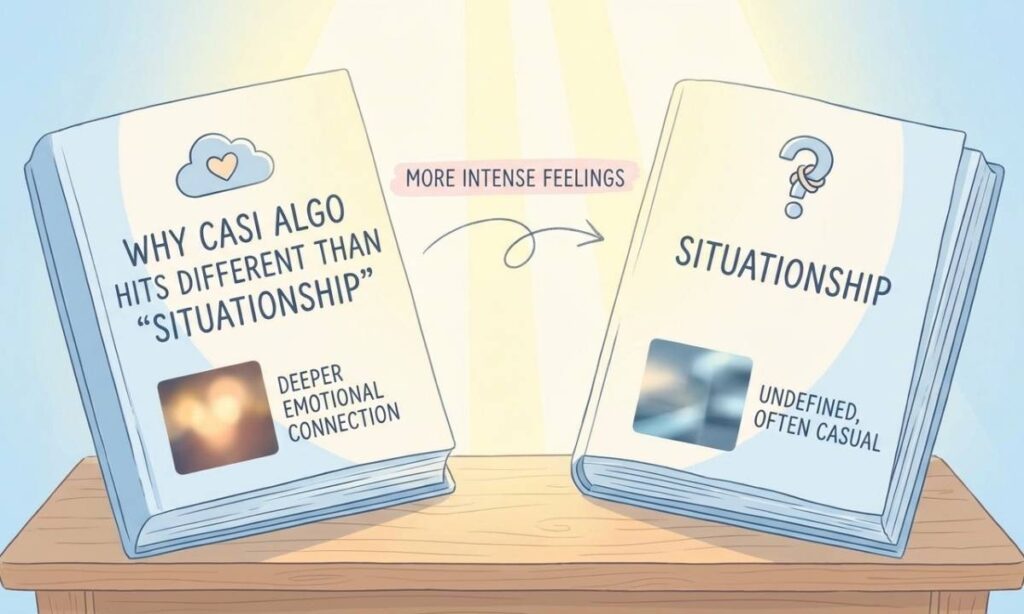
Both phrases describe undefined relationships. But they don’t carry the same emotional weight.
| Aspect | Casi Algo | Situationship |
| Origin | Spanish-language dating culture | English-language dating culture |
| Emotional tone | Nostalgic, bittersweet, almost mournful | Casual, sometimes noncommittal by design |
| Focus | What the connection almost became | What the connection currently is |
| Typical usage | Often used after it ends, reflecting on missed potential | Often used while it’s happening |
| Cultural feel | Poetic, tied to music and social captions | Practical, dating-app terminology |
In short, a situationship describes a status. Casi algo meaning describes a feeling — the ache of knowing something real was right there and still didn’t happen.
The Emotional Psychology of a Casi Algo
Undefined relationships create a specific kind of emotional strain. Psychology has a term for part of this experience: ambiguous loss.
Ambiguous loss happens when something ends without clear closure. No clean breakup. No defined reason. No formal goodbye.
That lack of closure makes it harder to move on, because the brain never gets the clear signal it needs to grieve properly.
A casi algo often produces:
- Hope mixed with uncertainty: you invest emotionally without knowing if it’s mutual
- Attachment without security: closeness builds, but nothing feels stable
- Delayed grief: since nothing was official, people often feel they aren’t “allowed” to grieve it, even though the loss is real
- Rumination: replaying conversations or moments, trying to figure out what it actually was
Understanding this pattern is usually the first step toward actually healing from it.
Therapists who study ambiguous loss note that people often need to create their own closure rituals when the other person never provides one. That might mean writing down what the relationship actually was, out loud, in your own words.
It might mean telling a friend the full story instead of shrinking it down to “it wasn’t a big deal.” Naming the experience reduces its power to keep looping in your head.
This is also why casi algo meaning resonates with therapists and relationship writers, not just teenagers on TikTok. It puts a name to a psychological experience that used to go undiscussed.
Casi Algo Beyond Romance: Other Uses of the Phrase

Casi algo meaning isn’t limited to dating. The phrase applies to any situation that came close to becoming real but didn’t follow through.
- A job offer that seemed certain, then quietly fell apart
- A friendship that almost became something deeper before circumstances changed
- A creative project or business idea that had momentum, then stalled
- A move, trip, or life plan that almost happened
In every case, the emotional thread is the same: real potential, real investment, and an outcome that never fully arrived.
Casi Algo on Social Media and in Pop Culture
Casi algo has become shorthand across TikTok, Instagram, and X for unresolved romantic history.
It’s commonly used as:
- A caption on throwback or nostalgic posts
- A hashtag on videos about modern dating struggles
- A recurring theme in Spanish language music about heartbreak with no clean ending
- A relatable phrase in memes about mixed signals and unclear intentions
The phrase “mi casi algo” adds a personal layer, referring to a specific person someone had this undefined connection with. Adding “mi” (my) turns a general concept into a very specific memory.
Its popularity online comes down to precision. It names something a lot of people have felt but struggled to put into words and that’s exactly what makes slang like this spread so quickly.
Music has played a big role too. Spanish-language artists have leaned into the phrase in lyrics about love that never quite landed, which pushes casi algo meaning further into mainstream conversation every time a new song goes viral.
Bilingual creators often translate the phrase for English speaking followers, which is part of why it now shows up in dating advice content outside Spanish speaking communities.
How to Navigate a Casi Algo Situation
If you’re currently in, or healing from, a casi algo, a few practical steps can bring clarity.
- Name it honestly: Acknowledge the connection was real, even without a label. This makes your feelings easier to process.
- Ask for clarity if it’s ongoing: A direct conversation about expectations can move things forward or bring the ambiguity to a clean end.
- Give yourself permission to grieve: Loss doesn’t need an official title to be valid.
- Limit reminders that keep you stuck: Muting, unfollowing, or taking space can stop you from replaying the situation on a loop.
- Reflect on the pattern, not just the person: If casi algo situations keep repeating, it may be worth examining what draws you toward undefined connections in the first place.
Closure doesn’t always come from the other person. Sometimes it comes from deciding, on your own, that “almost” is answer enough.
It also helps to set a boundary for future connections. If you notice you keep landing in casi algo territory, try asking about intentions earlier instead of waiting months for clarity.
That single habit can save you from repeating the same ambiguous pattern with someone new.
Frequently Asked Questions
What does casi algo meaning translate to in English?
It translates to “almost something,” describing a relationship or connection that never became official.
Is casi algo the same as a situationship?
They’re closely related, but casi algo carries more emotional and nostalgic weight, while situationship is a more casual, English-language term.
Why do people say “mi casi algo”?
Adding “mi” (my) makes the phrase personal, referring to one specific person the speaker had this undefined connection with.
Can casi algo meaning apply outside of romance?
Yes. It can describe any near-miss situation, like a job, friendship, or opportunity that almost happened but didn’t.
Is a casi algo always painful?
Not always, but the lack of closure usually makes it harder to process than a clearly defined breakup.
How do you get over a casi algo?
Acknowledge the connection was real, allow yourself to grieve without needing a label, and create distance from reminders that keep you attached.
Conclusion
Casi algo meaning captures something a lot of relationships never say out loud: real connection, real feelings, and no real ending.
Whether it shows up in love, friendship, or a missed opportunity, the phrase gives language to a common, very human experience coming close to something meaningful without ever fully getting there.
Recognizing a casi algo for what it is can be the first step toward healing from it, setting clearer expectations going forward, and knowing when “almost” isn’t enough anymore.
2 thoughts on “Casi Algo Meaning: What It Really Means in Love and Life”