
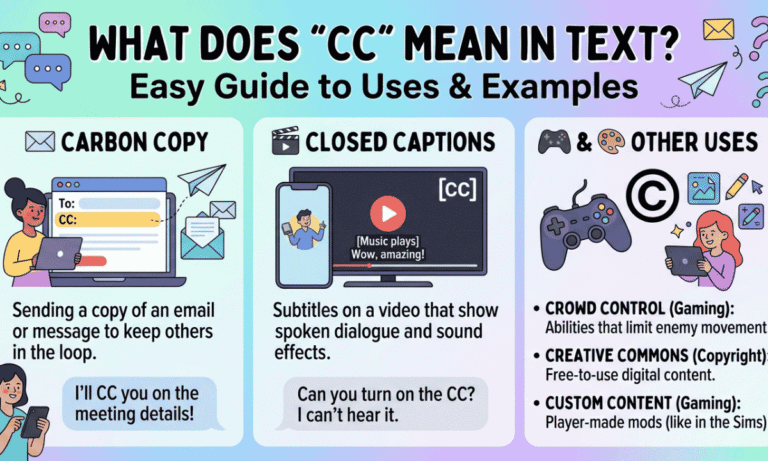
CC meaning in text is simple at its core. It stands for “carbon copy,” and it tells someone they are being kept in the loop. Think of it as a polite way to say, “You should see this too.”
You have probably spotted it in emails, group chats, and TikTok comments. But those two little letters can also mean closed captions, copy and paste, or even coloring credit on Instagram edits. Context changes everything.
This guide explains every use, with real examples and easy replies. No jargon, no confusion. Let’s break it down.
CC Meaning in Text : Quick Definition
Simple Definition
CC stands for “carbon copy.” In a message, it means you are sending a copy to someone who is not the main recipient.
The CC meaning stays close to this idea on almost every platform. The extra person is informed, but they are not expected to take action.
Key Points
- CC stands for “carbon copy,” and some people say “courtesy copy.”
- The main recipient goes in the “To” field.
- CC’d people can see the message and every other recipient.
- It shares information. It does not demand action.
- It is common in emails, work chats, and group threads.
- In other settings, CC can mean closed captions, copy and paste, or coloring credit.
Quick Examples
- “I’m CC’ing Sara so she has the details.”
- “Please CC me on the final invoice.”
- “CC: Mark, Finance Team”
- “CC this link to your brother.” (meaning copy and paste it)
- “CC: @lenscraft” on an edit (meaning coloring credit)
Origin & Background of the Term CC
The Typewriter Era
Before photocopiers, offices used carbon paper. It was a thin sheet coated with dark ink. Workers placed it between two pages and typed on the top one.
The pressure pushed ink onto the bottom page. That second page was the “carbon copy.”
The CC meaning started right here. Typists wrote “cc:” at the bottom of a letter to show who else received a copy.
Email Adoption
Early email designers borrowed office habits. The “Cc” header appeared in early email standards, including RFC 822 in 1982. Soon after, “To,” “Cc,” and “Bcc” became the standard trio.
Nobody used carbon paper anymore. The name stuck anyway.
Today, many people read it as “courtesy copy.” That fits how we use it now. You copy someone as a courtesy, so they stay informed.
Internet & Messaging Culture
Chat apps and social media borrowed the term next. People began typing “CC” in group chats, comments, and captions.
Slang then gave it new jobs. Creators use it for credits. Viewers use it for captions. Friends use it as a quick tag.
That is why the CC meaning in text feels different from one app to another. The core idea, “include this person,” keeps showing up.
Real Life Conversations Using “CC”

WhatsApp Conversation
Riya: Team, the client moved the call to 4 PM.
Riya: CC Ahmed. He is covering for Zain today.
Ahmed: Got it. Thanks for looping me in.
Here, CC adds Ahmed to the conversation. He needs the update, but he is not the main person assigned.
Instagram DM Example
Hina: Sent you the shoot schedule. CC’ing Bilal so he can book the studio.
Sana: Perfect. Bilal, please confirm tonight.
The CC works like a soft invitation. Bilal sees the plan without being the main contact.
Text Message Example
Dad: CC your sister on the flight details.
You: Done. Copied and sent.
This one uses the “copy and paste” sense. Dad wants the details forwarded, so the message reads like a quick instruction.
TikTok Comment Style
TikTok has three common uses:
- “Turn on CC if you can’t hear it.” (closed captions)
- “cc @maya, you need to see this.” (tagging a friend)
- “cc: @lenscraft” under an edit (coloring credit)
All three are valid. Always check the surrounding text to know which one applies.
Emotional & Psychological Meaning Behind Using CC

The CC meaning goes beyond the literal definition. Adding a person to a message sends a quiet signal. Here is what that signal can say.
Transparency
CC shows that nothing is hidden. Everyone on the thread sees the same information.
This builds trust. People feel safe when they know who else is reading.
Accountability
A CC creates a record. When a manager or teammate is copied, the message becomes harder to ignore or forget.
People tend to follow through when others are watching. That is why CC is popular for deadlines.
Inclusion
Being CC’d can feel good. It says, “You matter to this project.”
Leaving someone off can feel like exclusion. Smart communicators copy the people who truly need to know.
Authority or Pressure
Sometimes CC is used as a quiet warning. Copying a boss on a small disagreement can feel like a threat.
Receivers often sense this immediately. Use it with care, because the tone can turn cold fast.
Usage of CC in Different Contexts
Social Media
On social platforms, the CC meaning shifts by app. On Instagram, it often means coloring credit. On TikTok, it can mean closed captions or a tag.
On X and Facebook, “cc” before a handle works like a friendly nudge. It tells that person to look at the post.
Friends & Relationships
Among friends, CC is light and playful. “cc my bestie” means “I’m sharing this with my best friend.”
In relationships, though, be careful. Copying a friend into a private argument can break trust. Keep sensitive talks one-on-one.
Workplace Communication
At work, CC is a core email tool. Use it to keep managers, clients, or teammates informed.
Good reasons to CC someone:
- They need to know the outcome.
- They may need to act later.
- You need a written record.
- A project involves several teams.
Avoid copying people “just in case.” It fills inboxes and hides what matters.
Casual vs Serious Tone
Casual use is short and relaxed. “cc you later” or “cc Sam” is fine in a group chat.
Serious use is more formal. “Please find the report attached. CC: Legal Department” signals a clear, professional record.
Match your tone to the setting. The same letters can feel friendly or firm.
Common Misunderstandings About CC
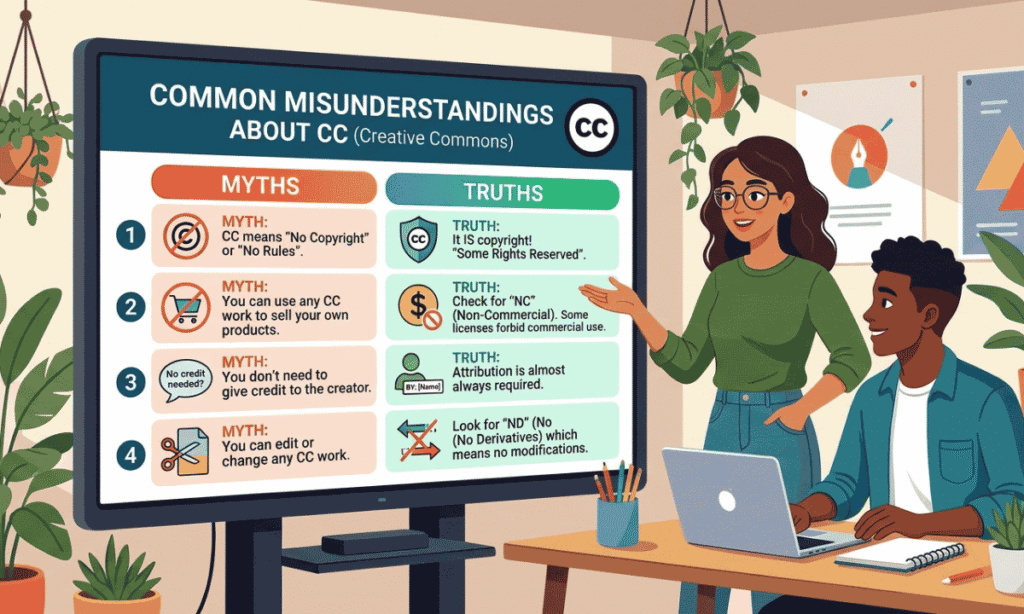
Mistake 1: Thinking CC Means Reply
CC does not mean “reply.” It means “for your information.” The CC’d person can respond, but they do not have to.
Mistake 2: Using CC Instead of BCC
CC shows every address to everyone. If you want privacy, use BCC.
This matters for large lists. Showing a hundred email addresses is a privacy risk.
Mistake 3: Overusing CC
Too many CCs create noise. People stop reading, and key messages get lost.
Ask yourself one question first. “Does this person truly need this?” If not, skip the CC.
Mistake 4: Assuming CC Requires a Response
Many people feel pressure when they are CC’d. They worry they must answer.
Usually, they don’t. Silence is fine unless the message names you directly.
Comparison Table: CC vs Similar Terms
The CC meaning is easier to grasp next to similar terms. Here is a quick comparison.
| Term | Full Form | Who Sees It | Response Expected? | Best Use |
| CC | Carbon copy | Everyone | Not usually | Keeping people informed |
| BCC | Blind carbon copy | Only sender and BCC’d person | No | Privacy, mass emails |
| To | Primary recipient | Everyone | Yes | Direct requests |
| Reply All | Reply to everyone | Everyone | Depends | Group discussions |
| FYI | For your information | Varies | No | Sharing quick updates |
| @Tag | Mention | Everyone in the chat | Often | Getting someone’s attention |
| CC (closed captions) | Closed captions | Viewers | No | Video accessibility |
Key Insight
CC is about awareness, not action. The “To” field is for people who must act. The CC field is for people who should know.
Variations and Related Expressions
1. CC Me
This asks someone to include you in a message. “Please CC me on that email” means “keep me informed.”
2. CC’ing You
This tells the receiver you are adding them. “CC’ing you so you’re in the loop” is a common friendly line.
3. CC the Team
This copies a whole group. It works well for updates that affect everyone.
4. CC the Manager
This adds a supervisor for visibility. Use it for status updates or approvals, not minor issues.
5. CC the Client
This keeps a client informed. Double check the content first, since clients see everything.
6. CC Everyone
This copies all involved parties. It is useful for big announcements but can feel noisy.
7. CC for Visibility
This explains your reason. It says, “I’m adding you so you can see this, nothing more.”
8. CC for Record
This signals documentation. It is common in legal, HR, and finance emails.
9. CC the Group
This adds a group list or chat. It is typical in community and project threads.
10. Double CC
This happens when someone is copied twice, often by accident. It can also mean two separate CC lines. Clean it up to avoid confusion.
How to Respond When Someone Uses CC
Your reply depends on the setting and the sender. Here are easy options.
Casual Replies
- “Thanks for looping me in!”
- “Got it, thanks.”
- “Appreciate the heads-up.”
Funny Replies
- “Oh, so I’m on the VIP list now?”
- “CC’d and proud.”
- “Carbon copy, but make it fashion.”
Mature / Professional Replies
- “Thank you for including me. I will review and follow up if needed.”
- “Noted. Please let me know if you need anything from my side.”
- “Thanks for the update. No action required from me.”
Respectful Replies
- “I appreciate being kept informed.”
- “Thank you for sharing this with me.”
- “Understood. I’ll stay available if the team needs support.”
Tip: Avoid “Reply All” unless your answer helps everyone. A quick private reply keeps inboxes clean.
Regional & Cultural Usage
Western Culture
In the US, UK, and Canada, CC is a daily workplace habit. Email etiquette guides teach it early. People expect brief, purposeful CCs.
Overuse is often seen as poor manners. Copying someone’s boss can feel like escalation.
Asian Culture
In many Asian workplaces, CC often reflects hierarchy. Copying seniors is common and shows respect.
In South Asia, CC is also a sign of formal record-keeping. Government and corporate emails often list long CC chains.
Middle Eastern Culture
Formal communication matters here. CC is often used to show proper channels and respect for rank.
Business emails may copy several senior contacts. This signals openness and shared responsibility.
Global Internet Usage
Online, the CC meaning is more flexible. Gamers, creators, and editors use it for credits and captions.
Younger users blend the meanings freely. That is why reading the context is the smartest habit.
Frequently Asked Questions
What is the CC meaning in text?
It means “carbon copy.” You send a message copy to someone who is not the main recipient.
What does CC mean on TikTok?
It usually means closed captions. It can also be a tag, like “cc @friend.”
What does CC mean on Instagram edits?
It means coloring credit. Editors credit the person who made the color grade.
Does CC mean I must reply?
No. CC is for awareness. You only reply if you have something useful to add.
What is the difference between CC and BCC?
CC shows all recipients to everyone. BCC hides those recipients from each other.
Can CC mean “copy and paste”?
Yes, in casual chats. “CC this link” just means copy and paste it.
Is CC still used today?
Yes. It remains standard in email and work chats, and it keeps evolving in slang.
Conclusion
The CC meaning in text is easy once you see the pattern. At heart, it means “carbon copy,” or keeping someone informed. Platforms like TikTok and Instagram add their own twists, such as captions and credits.
Use CC with purpose. Copy only people who truly need to know. Choose BCC for privacy, and never use CC as a pressure tool.
Now you know the CC meaning, its history, and how to reply. Use it wisely, and your messages will always feel clear, polite, and professional.
1 thought on “CC Meaning in Text: Easy Guide to Uses and Examples”