
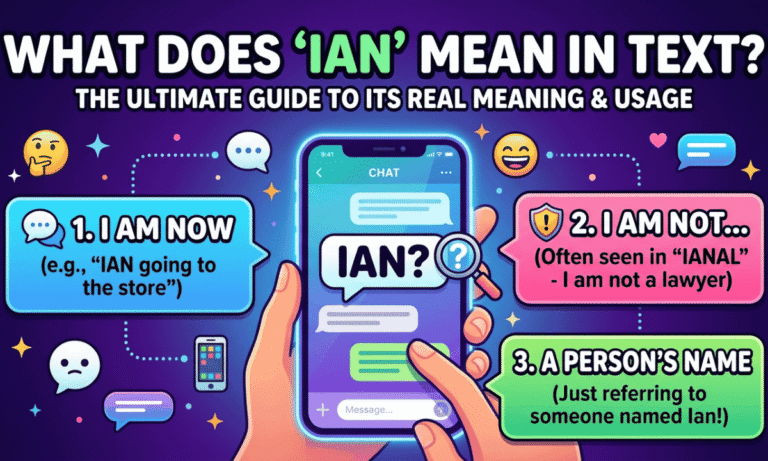
Ian meaning in text is easier to understand than it looks. Most people see “ian” and think of a person’s name. In chats, though, it usually stands for “I ain’t” or “I’m not.”
You may have spotted it in a DM, a TikTok comment, or a WhatsApp reply. It looks like a typo, but it is a real texting shortcut.
This guide explains where it came from, how people use it, and how to reply. You will also learn what “ian” means in the Bible, in dentistry, and in Korean. No fluff, just clear answers with real examples.
Ian Meaning in Text Quick Meaning
In texting and online slang, “ian” most often means “I ain’t” or “I am not.” People use it to deny, refuse, or push back in a casual way.
Simple Definition:
“ian” = I ain’t / I am not. It is informal slang used in fast, relaxed chats.
Quick Examples:
- “ian going out tonight” : I’m not going out tonight
- “ian interested tbh” : I’m not interested, to be honest
- “ian dealing with that drama” : I’m not dealing with that
- “ian mad, just tired” : I’m not mad, just tired
Notice there is no apostrophe and no space. That is how this slang works.
The full sentence tells you the meaning right away. If a verb or feeling follows “ian,” it is almost always a negative.
Origin & Background
This slang comes from speech. Many English speakers say “I ain’t” in daily talk. When people type the way they talk, “I ain’t” gets squeezed into “ian.”
Phone typing made the habit stronger. Small keyboards, quick replies, and fast-moving apps all push people toward shortcuts.
Think of “gonna,” “wanna,” and “gotta.” They started as spoken sounds and became written words. “Ian” follows the same path.
The word “ain’t” is much older than texting. It has lived in casual speech and regional dialects for a long time. The typed version is newer and has no single inventor.
Here are the main forces behind it:
- Phonetic typing (spelling words how they sound)
- Mobile-first messaging
- Short-form platforms like TikTok and Instagram
- Meme culture and Gen Z humor
So the ian meaning in slang grew naturally. It did not come from one viral post or one famous person.
Ian Meaning in Slang
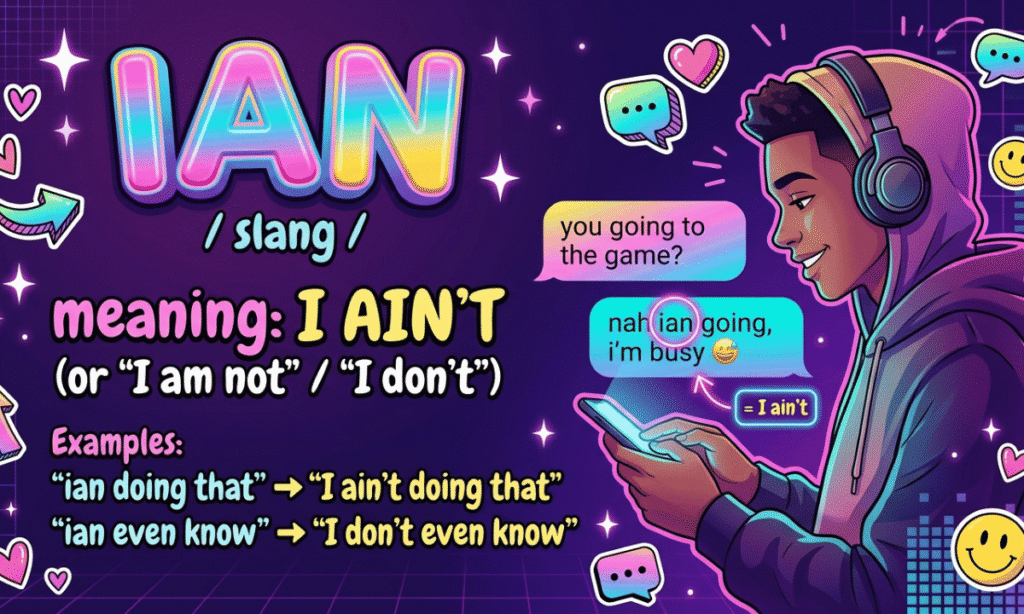
In slang, “ian” is a negation tool. It replaces “I ain’t” or “I’m not” at the start of a sentence.
It is usually followed by a verb or a feeling. Think “ian going” or “ian worried.”
A few rules of thumb:
- It works in the first person only (“I”).
- It sounds casual, never formal.
- It often signals a firm boundary.
- Tone depends on the situation and the people involved.
Some websites also describe “ian” as a loose form of “I am not.” Both readings land in the same place. It is a quick, low-effort “no.”
You will rarely see “ian” in full essays or news stories. It lives in chats, captions, and comments.
Ian Meaning in Bible

The Bible does not contain the word “ian” as slang. People still search for it because of the name Ian.
So the ian meaning in the Bible comes down to the name’s roots. Ian is the Scottish Gaelic form of John.
John comes from the Hebrew name Yochanan. It means “God is gracious” or “Yahweh has shown favor.”
The name traveled a long way:
- Hebrew: Yochanan
- Greek: Ioannes
- Latin: Iohannes
- Scottish Gaelic: Iain / Ian
From the same root came John, Jean, Juan, and Giovanni. Biblical figures like John the Baptist and John the Apostle carry this name family.
So the name Ian has deep Christian roots. The word itself, though, is not written in Scripture.
IAN Meaning Dental
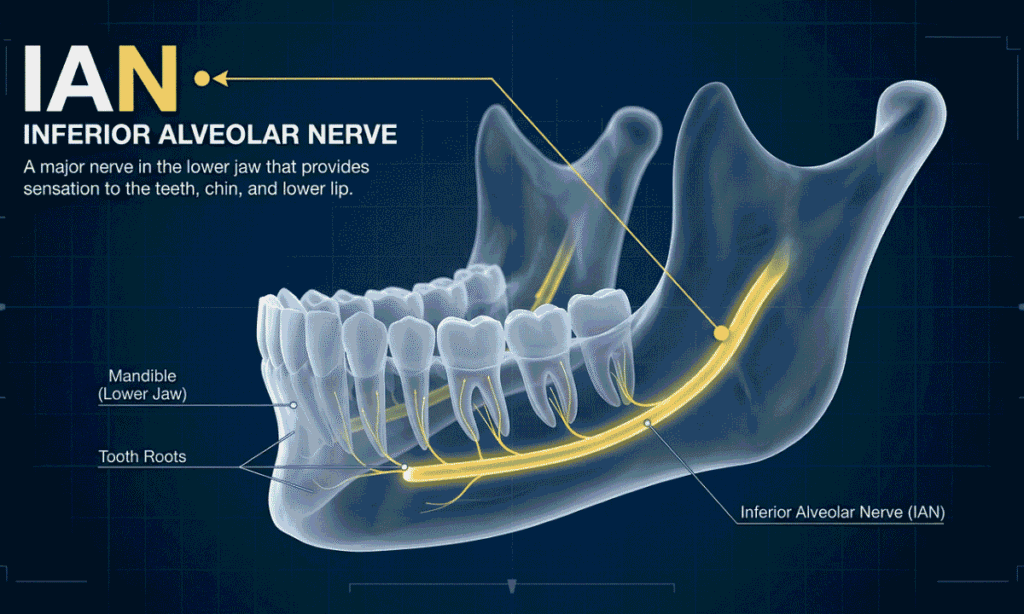
In dentistry, IAN stands for the inferior alveolar nerve. This nerve runs through the lower jaw. It carries feeling from the lower teeth, lower lip, and chin.
You will often see it in the phrase “IAN block” or “IANB.” It is the most common injection used to numb the lower teeth.
That is the full dental ian meaning. It has nothing to do with texting.
Dentists may use an IAN block for:
- Fillings and crowns
- Lower molar extractions
- Root canal treatment
- Deep gum cleaning
After the shot, your lip and tongue may feel numb for a few hours. Be careful not to bite them.
If the numbness or bleeding lasts a day or more, contact your dentist. This is general information, not medical advice.
Ian Meaning Korean

In Korea, Ian is written 이안 and pronounced “Ian.” It is used as a given name.
Many K pop fans know it through idols who go by Ian, including members of Hearts2Hearts and LUN8.
So the ian meaning in Korean is mostly about names, not slang.
There is one fun overlap. Korean uses the word 안 (an) before a verb to say “not.” For example, 안 가 means “not going.”
This is only a coincidence. English slang “ian” and Korean 안 are unrelated. Still, both express a quick “not.”
Real Life Conversations (How People Actually Use It)
Chats show the slang best. These short examples show the ian meaning in action.
WhatsApp Chat
Person A: Football at 6?
Person B: ian making it, got work late
Instagram DMs
Person A: Did you see my story?
Person B: ian seen it yet, sending now
TikTok Comments
User 1: Everyone loves this song.
User 2: lol ian vibing with it
Text Message
Person A: Are you upset with me?
Person B: ian upset, just drained today
Each reply is short and relaxed. The sender saves time and still gets the point across.
Emotional & Psychological Meaning
“Ian” is more than a shortcut. It also carries a mood. The ian meaning often shows how someone feels in that moment.
People use it when they want to say no without a long explanation. It feels direct but not dramatic.
What it often signals:
- Relaxed attitude: the sender is casual, not stressed
- Disinterest: “I’m not into this”
- Emotional distance: the sender wants to stay out of it
- Bluntness: a clear no, with no extra words
- Boundary setting: “ian arguing today” ends a topic
For example, “ian bothered” can show calm confidence. It can also show someone pulling back.
Context decides which one it is. Check the emojis, the earlier messages, and your history with the person.
Usage in Different Contexts
The ian meaning stays the same everywhere. The tone, however, changes with the setting.
1. Social Media
“Ian” is common in captions, comments, and replies on Instagram, TikTok, and X.
Example: “ian chasing trends this year.”
The tone is casual, expressive, and a little bold.
2. Friends & Relationships
Friends use it to keep things light:
- “ian mad at you”
- “ian ignoring you, just busy”
It can reassure people. But in a tense talk, it may sound cold. Add an emoji or a friendly word to soften it.
3. Work or Professional Settings
Avoid it. In emails or work chats, “ian” can look unclear and unprofessional.
Try these instead:
- “I’m not available until 3 PM.”
- “I haven’t finished that yet.”
- “I’m not able to attend.”
4. Casual vs Serious Tone
| Tone | Example | Okay to use? |
| Casual | “ian going” | ✅ Yes |
| Friendly | “ian upset lol” | ✅ Yes |
| Serious | “ian responsible” | ⚠️ Risky |
| Professional | “ian attending the meeting” | ❌ No |
Common Misunderstandings
Because “ian” has many meanings, mix-ups are common. Here are the big ones. Clearing them up makes the ian meaning much easier to read.
1. Thinking “Ian” is always a name
Many people assume it points to a person named Ian. Capital letters and context help.
- “Ian said that” → a person
- “ian said that” → likely slang, but it is unclear without context
2. Misreading the tone
“Ian” can sound dismissive, cold, or uninterested. The sender may not mean it that way.
When in doubt, ask. A quick “you good?” clears things up.
3. Using it in the wrong setting
Do not use it in:
- Emails
- Job applications or interviews
- Formal messages to teachers or managers
4. Confusing it with typos
Some readers think “ian” is a typo for “I am” or “Iain.” In slang use, it is intentional.
Comparison Table
| Term | Meaning | Tone | Where it is used |
| ian | I ain’t / I’m not | Casual | Texting, social media |
| I’m not | Standard form | Neutral | Everywhere |
| ain’t | Informal “am not / is not” | Casual | Speech, informal writing |
| nah | No | Very casual | Quick replies |
| idc | I don’t care | Blunt | Casual, emotional chats |
Key Insight:
The ian meaning sits between spoken slang (“ain’t”) and digital shorthand. It feels natural, but it is still informal.
Variations / Types of “Ian”
The ian meaning shifts a little with each word that follows it. Here are common patterns:
- ian know: I don’t know (uncertainty)
- ian going: I’m not going (refusal)
- ian doing that: I’m not doing that (strong boundary)
- ian ready: I’m not ready (hesitation)
- ian interested: no interest (often blunt)
- ian mad: I’m not angry (reassurance)
- ian replying: I’m not replying (can sound dismissive)
- ian worried: I’m not worried (calm or confident)
- ian sure: I’m not sure (casual doubt)
- ian tryna: I’m not trying to (avoidance)
How to Respond When Someone Uses “Ian”
Your reply depends on the mood. The ian meaning is usually a soft no, so keep your answer relaxed too.
Casual Replies
- “Alright, no worries”
- “Got you”
- “All good 👍”
Funny Replies
- “ian listening either 😂”
- “ian surprised tbh”
Mature / Confident Replies
- “Okay, I understand”
- “Thanks for letting me know”
Private / Respectful Replies
- “That’s totally fine”
- “Take your time”
Regional & Cultural Usage
Slang spreads fast online. Still, use differs by region and language.
Western Culture
The ian meaning is most common among younger users in English-speaking countries. It matches the way people already talk.
Asian Culture
Use is less common. It mostly appears among people who follow Western internet slang. In Korea, the ian meaning usually points to the name 이안.
Middle Eastern Culture
English slang is growing among bilingual youth. Many mix English and Arabic in the same chat, and “ian” fits easily into that style.
Global Internet Usage
Today the ian meaning travels through TikTok, Instagram, and gaming chats. It spreads because it is:
- Short
- Easy to type
- Clear in tone
Frequently Asked Questions
What is the ian meaning in text?
In texting, “ian” usually means “I ain’t” or “I’m not.” It is casual slang.
Is “ian” a real word?
Not in formal English. It is internet slang, not a dictionary word.
Is “ian” rude?
Not always. It can sound blunt or cold depending on tone and context.
Can I use “ian” in professional messages?
No. Use clear, full phrases like “I’m not available.”
Why do people use “ian” instead of “I’m not”?
It is faster to type. It also gives a relaxed, casual tone.
Does the ian meaning change with tone?
Yes. The core meaning stays “I’m not,” but tone can make it sound friendly, blunt, or cold.
What does IAN mean in dentistry?
It stands for the inferior alveolar nerve in the lower jaw.
What does Ian mean in the Bible?
The word is not in the Bible. The name Ian is the Scottish form of John, meaning “God is gracious.”
Is Ian a Korean name?
It is used in Korea as a given name, written 이안 and pronounced “I-an.”
Conclusion
The ian meaning depends on where you see it. In chats, it almost always means “I ain’t” or “I’m not.” In dentistry, it is a nerve. As a name, it comes from John and means “God is gracious.”
For texting, remember three things. Read the context. Watch the tone. Keep it out of formal messages.
Used well, “ian” makes your chats feel natural. Used in the wrong place, it can look careless. Match the word to the moment, and your message will land the way you intend.
3 thoughts on “Ian Meaning in Text: Best Guide to Its Real Meaning & Usage”