
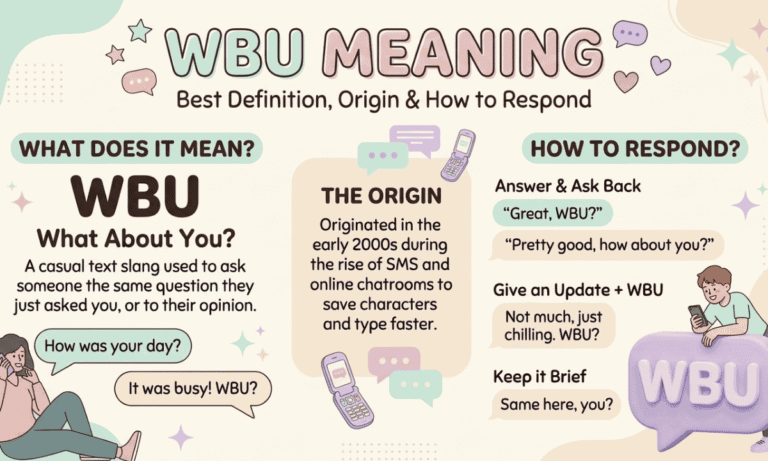
WBU meaning is simple: it stands for “what about you?” People type it to pass the conversation back to the other person. It takes three letters and saves a lot of typing.
You will see it in texts, DMs, comments, and group chats. It feels casual, friendly, and a little curious. But the tone can shift depending on who sends it and where.
This guide breaks down the WBU meaning, its origin, real chat examples, and the best ways to reply. Whether you are new to texting slang or just want smarter replies, you are covered.
WBU Meaning: Quick Explanation
WBU meaning in text: “What about you?” Some people also read it as “how about you?”
It is a follow up question. You answer a question about yourself, then use WBU to ask the same thing back.
Quick facts:
- Full form: What about you
- Type: Texting slang and internet abbreviation
- Tone: Friendly, casual, curious
- Used on: WhatsApp, Instagram, TikTok, Snapchat, SMS
- Other meaning: World Boxing Union (in sports)
Here is a simple example:
“I’m good, just tired. WBU?”
That is all there is to it. The sender shares a little and asks you to share too.
Origin & Background of WBU
WBU belongs to the same family as LOL, BRB, and IDK. These short forms grew out of fast, typed conversation.
Typing “what about you” takes time on a small phone keyboard. Three letters do the same job.
Where It Started
WBU likely began in early chat rooms and instant messaging. Platforms like AOL Messenger and MSN pushed users to type fast. Abbreviations were a natural fix.
SMS limits made it even more useful. Early text messages had strict character caps. Short forms saved space and money.
How It Evolved
At first, WBU appeared in lowercase, often with no punctuation. Over time, people added question marks and emojis.
Smartphones changed things again. Autocorrect and predictive text made long phrases easier. Yet WBU stayed popular because it sounds relaxed.
Today it works as a polite conversation bridge. It shows interest without sounding formal.
Cultural Influence
Gen Z and millennials helped spread WBU across social apps. It now shows up in comment sections, story replies, and voice-note captions.
The slang also shaped how people talk offline. Some say “wibu” out loud, though that is rare and can be confused with another term.
Most importantly, WBU made small talk faster. It keeps chats balanced, so one person does not do all the talking.
Real Life Conversations Using WBU (Mandatory Examples)
Examples show the WBU meaning better than any definition. Here are common chat settings.
WhatsApp Chat
Ali: Hey, how was your day?
Sara: Pretty busy. Work was crazy. WBU?
Ali: Same here. Just got home.
In this chat, Sara answers first. Then she hands the question back. It feels natural and polite.
Instagram DMs
Mia: Love your story from the beach!
Jake: Thanks! It was a great weekend. WBU, any plans?
Mia: Nothing yet. Maybe a movie night.
On Instagram, WBU often follows a compliment. It keeps the DM going.
TikTok Comments
User 1: This song is my current obsession.
User 2: Same! Been on repeat all week. WBU?
User 1: Since Monday, honestly.
In comments, WBU invites other viewers to share. It boosts replies and engagement.
Text Message
Dad: Dinner at 7?
Zain: Sure, I’ll be there. WBU, need anything?
Dad: Just bring bread.
Here, WBU is a light, friendly check in. It does not feel pushy.
WBU meaning boxing

Outside slang, WBU also stands for the World Boxing Union. It is a boxing sanctioning body, smaller than the famous WBA, WBC, IBF, and WBO groups.
It has awarded its own world titles over the years. Boxing fans may see “WBU champion” in fight records.
The context makes it obvious. If you see WBU next to belts, fighters, or rankings, it is about boxing. If it sits at the end of a chat message, it means “what about you?”
WBU meaning business

In a business setting, the WBU meaning depends on the company. Many firms use WBU as shorthand for a “business unit.” Examples can include a wireless or wholesale business unit.
Always check internal documents before assuming. Acronyms differ from one organization to another.
In work chat apps like Slack, though, colleagues may still use WBU casually. A quick “Busy week here, WBU?” is common among teammates.
Wbu meaning in chat
The wbu meaning in chat is almost always “what about you?” It appears at the end of a sentence, usually as a question.
Chat tone matters here. A short “wbu” with no punctuation feels relaxed. “WBU?!” with emojis feels excited.
Common patterns in chat:
- Answer first, then “wbu?”
- Start with “wbu?” after someone shares news
- Reply with only “wbu?” to keep things moving
Good wbu meaning
People often search for a “good wbu meaning.” This usually refers to a positive reply like “Good, wbu?”
Here, “good” answers “how are you?” and WBU returns the question. It is one of the most common chat patterns online.
Example:
Friend: How are you?
You: Good! Just chilling. WBU?
It is polite, short, and friendly. It also signals you are open to a longer chat.
Wbu meaning from a girl

The wbu meaning from a girl is the same: “what about you?” The words do not change by gender.
What changes is the signal. In a flirty chat, WBU from a girl can show interest. She wants to hear more about you.
Look at the clues:
- Emojis and warmth: Likely friendly or flirty
- Quick replies: Likely engaged
- Dry, one word style: Likely casual or neutral
Do not over-read it. WBU is a conversation tool first. Context decides the rest.
Emotional & Psychological Meaning Behind WBU
The WBU meaning goes beyond three letters. It reflects how people connect.
Why People Use It
People use WBU for several reasons:
- To keep the chat balanced
- To show they care
- To avoid awkward silence
- To save time typing
It is a small act of courtesy. It says, “I shared, now your turn.”
Emotional Signals
WBU can carry different emotions:
- Warmth: The sender wants a real answer
- Politeness: The sender follows social habit
- Curiosity: The sender wants to know you better
- Fatigue: The sender is wrapping up with a quick question
Pay attention to the rest of the message. A long, upbeat text with WBU shows real interest. A short, flat one may be routine.
Personality Traits It Reflects
Frequent WBU users often come across as:
- Friendly and approachable
- Considerate of others
- Relaxed and informal
- Socially aware
Some users may also be shy. WBU gives them an easy way to keep a chat alive without asking deep questions.
Usage in Different Contexts
The WBU meaning stays the same everywhere. The tone, however, shifts with the setting.
Social Media
On social apps, WBU is everywhere. It shows up in comments, DMs, and story replies.
Creators use it to spark interaction. A caption like “Best movie this year? Mine is Dune. WBU?” invites replies and lifts engagement.
Friends & Relationships
With friends, WBU feels natural. It signals easy, equal conversation.
In romantic chats, it can show interest. Asking “wbu?” after sharing something personal says, “I’d like to hear your side.”
Partners also use it for daily check-ins. It keeps both sides involved.
Work or Professional Settings
In professional chats, be careful. WBU can feel too casual in emails or client messages.
Better options include:
- “And you?”
- “How about yourself?”
- “What about your side?”
With close coworkers on Slack or Teams, WBU is usually fine. Match your team’s style.
Casual vs Serious Tone
WBU suits casual talk best. In serious moments, it can feel flippant.
Compare these two:
- Casual: “Had pizza tonight. WBU?” (fits perfectly)
- Serious: “My grandfather passed away. WBU?” (feels wrong)
When emotions run high, use full sentences. Say, “How are you holding up?” instead.
Common Misunderstandings About WBU
Slang creates confusion. Here are the main mix-ups.
Thinking It’s Rude
Some people think WBU is lazy or cold. It is not, in most cases.
Rudeness depends on tone, not the acronym. “WBU?” after a warm message is friendly. A dry “wbu” after a long, heartfelt text may feel dismissive.
Using It Without Answering
Many people send “wbu?” without sharing anything first. This can feel odd.
If someone asks “How was your day?” and you reply only “wbu?”, you skipped your turn. Answer first, then ask back.
Using It With Strangers in Formal Spaces
WBU does not fit every audience. Sending it to a hiring manager or a new client may look unprofessional.
Stick to complete phrases in formal settings. Save slang for people who already know your style.
Overusing It
Even a good tool gets stale. If every message ends with “wbu?”, the chat starts to feel mechanical.
Mix it up. Ask specific questions instead. “What did you cook?” feels warmer than another “wbu?”
Read More Moots Meaning In Text
Comparison Table: WBU vs Similar Terms
Here is how WBU compares with related phrases.
| Term | Full Form | Tone | Best Used In |
| WBU | What about you | Casual, friendly | Texts, DMs, comments |
| HBU | How about you | Casual, friendly | Texts, DMs |
| WBY | What about you | Very casual | Quick chats |
| HRU | How are you | Polite, simple | Greetings |
| AYT | Are you there | Direct | Checking presence |
| And you? | And you | Neutral, polite | Mixed or semi-formal |
| How about yourself? | How about yourself | Formal, warm | Work or formal talk |
The main difference between WBU and HBU is small. Both return the question. HBU can feel slightly softer, while WBU is more common.
Variations & Types of WBU
Slang evolves. Here are nine variations you may see.
- WBU: The standard form, “what about you?”
- Wbu?: Lowercase with a question mark, very casual
- WBU?!: Adds excitement or urgency
- WBUUU: Stretched letters for a playful, warm tone
- Wbu tho: Adds “though,” often after a surprise or contrast
- WBU and ur family?: Extends the question to loved ones
- Wbu 😊: Paired with an emoji for friendliness
- HBU: “How about you,” a close cousin
- WBU fr?: “For real,” a more sincere ask
Each version tweaks the mood. Longer spellings usually feel warmer. Short ones feel quick and casual.
How to Respond When Someone Uses WBU
The best reply answers the question. Then you can ask something back.
Here is a simple formula:
- Answer honestly
- Add one small detail
- Return the question or ask a new one
Casual Replies
Use these with friends:
- “I’m good, just relaxing. You?”
- “Pretty chill today. Nothing much.”
- “Can’t complain! How’s your day going?”
- “Doing well, thanks for asking.”
Funny Replies
Humor works in relaxed chats:
- “Surviving on coffee and pure hope. WBU?”
- “Living the dream, or at least napping through it.”
- “Still alive, which counts as a win.”
- “Busy doing absolutely nothing. WBU?”
Keep jokes light. Avoid sarcasm if you are unsure how the person will take it.
Mature / Confident Replies
These suit adult or semi-professional chats:
- “I’m doing well, thank you. How about yourself?”
- “Good progress today. Looking forward to the weekend. And you?”
- “All good on my end. How are things with you?”
They sound calm and polished. They also keep the conversation respectful.
Private or Respectful Replies
Sometimes you do not want to share much. That is fine.
Try:
- “Keeping things low-key today. How are you?”
- “I’d rather not get into it, but thanks for asking.”
- “Taking it one day at a time. WBU?”
These replies protect your privacy. They also stay polite.
Regional & Cultural Usage
The WBU meaning is global. Local habits, however, shape how it is used.
Western Culture
In the US, UK, Canada, and Australia, WBU is extremely common. Teens and young adults use it daily.
It often follows “good” or “not much.” Casual tone is the norm, and few people find it rude.
Asian Culture
In countries like India, Pakistan, the Philippines, and Singapore, English slang mixes with local languages. WBU appears in Hinglish, Taglish, and Roman Urdu chats.
For example: “Main theek hoon, wbu?” Many users also add polite phrases, since respect in conversation matters.
Middle Eastern Culture
In the Middle East, chat style leans warm and respectful. People often greet at length before asking questions.
WBU appears among younger users, usually mixed with Arabic phrases. Elders and formal contacts may prefer full greetings.
Global Internet Usage
Online, WBU crosses borders. Gaming chats, Discord servers, and social apps all use it.
Because it is short and clear, it works even for non-native English speakers. That is one reason the WBU meaning stays so widely understood.
Frequently Asked Questions
What does WBU mean in text?
WBU means “what about you?” It asks the other person to share their own answer.
What does WBU mean from a girl?
It means the same thing: “what about you?” In flirty chats, it may show interest.
Is WBU rude?
No, WBU is not rude by itself. Tone and context decide how it feels.
What is the WBU meaning in boxing?
In boxing, WBU stands for the World Boxing Union. It is a sanctioning body that awards titles.
How do I reply to WBU?
Answer the question first. Then add a detail or ask something back.
What is the difference between WBU and HBU?
WBU is “what about you,” and HBU is “how about you.” Both mean nearly the same.
Can I use WBU in professional emails?
It is best to avoid it. Use “and you?” or “how about yourself?” instead.
Does the WBU meaning change on Instagram or TikTok?
No, the WBU meaning stays the same across apps. Only the tone changes.
Conclusion
The WBU meaning is easy to remember: “what about you?” It keeps conversations balanced and shows you care about the other person.
Now you know where it came from, how it works in chats, and what it means in boxing and business. You also have replies for every mood, from funny to formal.
Use WBU with people who know your style. Answer first, then ask back. Do that, and your chats will feel natural and warm.
2 thoughts on “WBU Meaning: Best Definition, Origin & How to Respond”