

No mames meaning is the first thing most learners ask about when they meet Mexican slang. You hear the phrase in songs, memes, and group chats. It sounds shocking, but the real idea is simple.
In daily talk, it works like “no way,” “come on,” or “you’re kidding.” The literal words are crude. Most speakers use them as a quick burst of disbelief, joy, or annoyance.
This guide covers the origin, tone, real chat examples, and smart replies. You will also learn when to avoid it.
No Mames Meaning : Quick Explanation
The no mames meaning is “no way,” “are you serious,” or “stop messing around.” It is informal Mexican Spanish. People use it to react to surprising, funny, or frustrating news.
The phrase comes from the verb mamar, which means “to suck.” That literal sense is vulgar. In practice, it acts as an interjection, not a sentence about the act itself.
Tone changes the no mames meaning completely. The same two words can sound thrilled, angry, or playful.
Quick answer: “No mames” is a vulgar-but-common Mexican slang expression meaning “no way!” or “you’ve got to be kidding.” Use it only with close friends.
Simple examples:
- “¡No mames! Ganamos el partido.” : No way! We won the game.
- “No mames, otra vez llegaste tarde.” : Come on, you’re late again.
- “No mames, qué buen concierto.” : Wow, what a great concert.
- “No mames, ¿en serio?” : Seriously? Are you kidding?
- “No mames, no tengo dinero.” : Ugh, I can’t believe I have no money.
Origin & Background of “No Mames”
The phrase belongs to Mexican street language. It spread through families, schools, neighborhoods, and later television and the internet.
No single person invented it. Like most slang, it grew from everyday speech.
Literal origin (not how people use it):
The root is mamar, a verb tied to sucking or nursing. In the negative form, no mames literally means “don’t suck.”
In crude speech, the verb can also have a sexual meaning. That is why the phrase feels strong to outsiders.
Still, native speakers rarely think about the literal image behind the no mames meaning. They treat it as a fixed expression, like “oh my God” in English.
How it evolved:
Over time, the phrase drifted far from its first meaning. People began using it to show surprise or disbelief. Then it picked up other shades, such as annoyance and excitement.
Slang words like wey (dude) and neta (truth) joined it. That gave us versions such as “no mames, wey.”
Then came texting. Typing the whole phrase takes time, so short forms appeared, like “nmms.” Social media, memes, and music pushed it across borders.
Today, the no mames meaning is understood well beyond Mexico. Many Spanish learners and U.S. Latino communities know it. But its strength still depends on where you are and who is listening.
Real Life Conversations (MANDATORY)
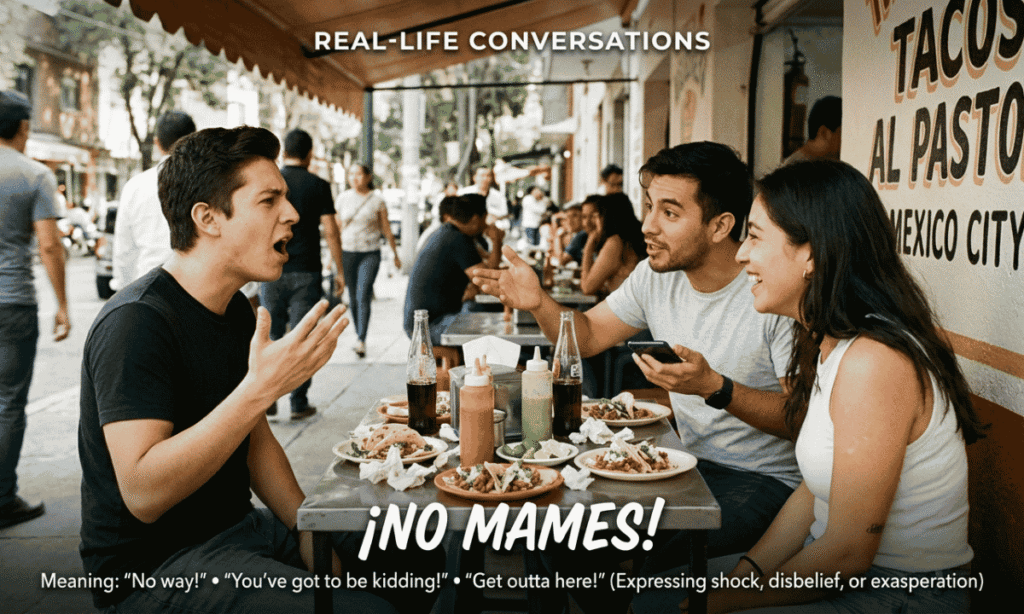
Examples make slang click. Here are three realistic chats. Each shows a different tone.
WhatsApp Chat (Friends)
Luis: Oye, ¿viste que Carla se va a Canadá?
Ana: ¿Qué? No mames, ¿cuándo?
Luis: El mes que entra. Ya tiene todo listo.
Ana: No mames, wey. ¡Nos va a dejar solos!
What it means: Ana feels shocked and a little sad. The phrase shows surprise, not anger.
Instagram DM
Mariana: Mira esta foto de mi gato con sombrero.
Diego: No mames, jajaja. ¡Está perfecto!
Mariana: Lo compré ayer 😂
Diego: No mames, necesito uno igual.
What it means: Diego is amused. Here the phrase means “that’s amazing.” The laughing emoji sets the mood.
TikTok Comments
- User 1: “No mames, ese truco es imposible.”
- User 2: “nmms, ¿cómo lo hizo?”
- User 3: “No mames, ya lo intenté y me caí 😭”
What it means: Viewers react with awe and humor. Short forms like “nmms” are common in comment sections.
Notice the pattern behind every no mames meaning example. In all three chats, the people know each other or share the same online space. That context is what makes the phrase feel normal.
Emotional & Psychological Meaning

The no mames meaning is less about words and more about feeling. It is an emotional release valve.
When something surprises us, we need a quick reaction. This phrase gives speakers a fast, strong way to react. It can lower tension, add humor, or show closeness.
Here are the main emotions it carries:
- Surprise: “No way, that really happened?”
- Disbelief: “I can’t believe you said that.”
- Frustration: “Come on, not again.”
- Excitement: “That’s awesome!”
- Playful teasing: “Stop it, you’re joking.”
Speakers also use the no mames meaning to build trust. Using strong slang with someone signals, “I’m relaxed around you.” That is why friends say it so freely.
But the same strength can backfire. In the wrong setting, it can sound disrespectful or aggressive. Voice volume, facial expression, and timing all shape how it lands.
Usage in Different Contexts
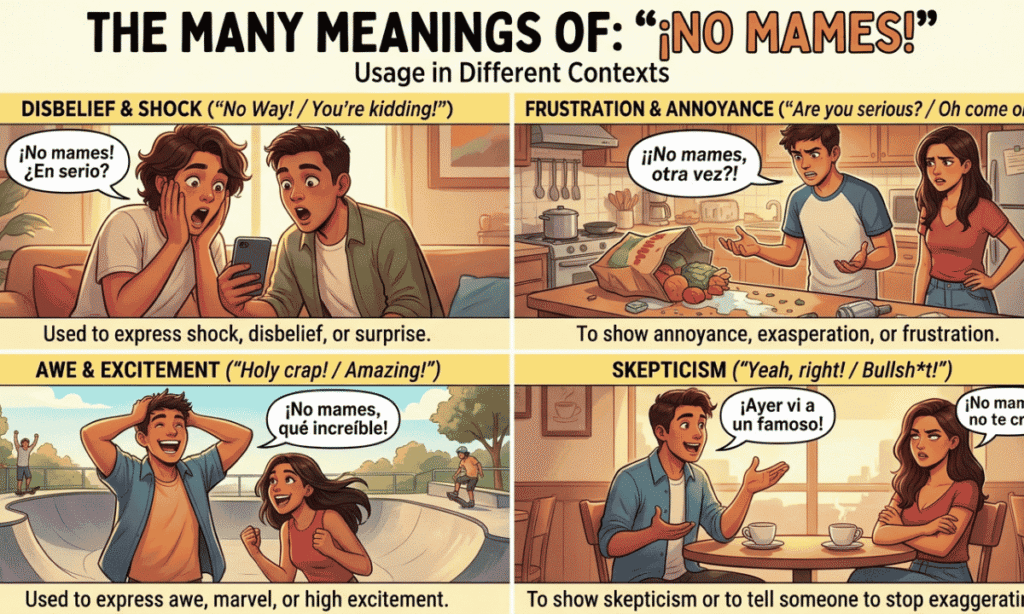
Where you say it matters as much as how you say it.
Social Media
Online, the phrase is everywhere. People drop it in captions, replies, and memes. It works well for reacting to viral clips, big news, or silly moments.
Short versions of the no mames meaning help in fast typing. Common forms include “nmms” and “no mms.” Emojis such as 😂, 😳, and 💀 often follow.
Still, public posts can reach unexpected readers. A brand account or a school page should skip it.
Friends & Relationships
This is the safest zone. Close friends use it all the time. It can show laughter, shock, or gentle teasing.
In romantic relationships, it can be cute or annoying depending on tone. A playful “no mames” after a joke feels warm. A sharp one during an argument can sound harsh.
With family, it depends. Many Mexican families allow it among siblings and cousins. Older relatives may dislike it.
Work or Professional Settings
Avoid it at work. It is vulgar in origin, and many coworkers will notice.
Even in friendly offices, it can seem unprofessional in meetings or emails. If you want to express surprise, try one of these:
- “¿En serio?” (Really?)
- “No lo puedo creer.” (I can’t believe it.)
- “¡Qué sorpresa!” (What a surprise!)
The exception is a casual chat with a close coworker, away from clients and managers.
Casual vs Serious Tone
The phrase fits casual moments best. It is light, fast, and emotional.
In serious talk, such as grief, legal matters, or formal complaints, it can feel out of place. A serious “no mames” can show real anger. That may escalate a tense moment.
Quick rule for the no mames meaning: if you would not swear in that setting, do not use this phrase either.
Quick safety checklist before you say it:
- Do you know the listener well?
- Is the mood relaxed and playful?
- Are you outside work, school, or formal events?
- Could a milder phrase like “no manches” do the same job?
- Would you be comfortable if a parent or boss overheard?
If you answer “no” to any of these, pick a softer phrase. This habit protects you from awkward moments and helps you sound natural, not careless.
Common Misunderstandings
Learners often misread slang. Here are the biggest mistakes about the no mames meaning.
1. Thinking it always means something sexual
The root word is crude. But in modern speech, the phrase rarely points to anything sexual. It works as an emotional reaction.
So do not picture the literal image each time you hear it. Look at the situation instead.
2. Assuming it’s always rude
It is vulgar, but not always rude. Among friends, it is normal and often funny.
Rudeness depends on the person, tone, and place. The same words can be a joke at a party and an insult at a funeral.
3. Using it with strangers
Saying it to someone you just met is risky. They may not share your sense of humor. They may also think you are being aggressive.
Wait until you know the person. Listen to how they speak first.
4. Using it in formal Spanish
Formal Spanish needs polite language. Presentations, interviews, and official emails are not the place for slang.
Use neutral phrases such as “no es posible” or “me sorprende” instead.
5. Translating it word for word
A literal translation (“don’t suck”) makes no sense in English. Slang works as a whole unit.
Translate the feeling, not the words. Think “no way,” “come on,” or “seriously?”
Comparison Table
This table compares the no mames meaning with similar expressions.
| Expression | Rough Meaning | Strength | Best Used With |
| No mames | No way / Come on | Strong, vulgar | Close friends |
| No manches | No way (milder) | Mild | Friends, family, casual groups |
| No inventes | Don’t make stuff up | Mild | Almost anyone casual |
| ¿En serio? | Really? | Neutral | Anyone, including work |
| ¡Órale! | Wow / Okay | Mild | Friends, casual settings |
| ¡No manches, wey! | No way, dude | Medium | Close friends |
| ¡No mames, wey! | No way, dude (strong) | Strong | Very close friends |
The table shows one thing clearly. “No manches” is the safer cousin. If you are unsure, pick it over the stronger version.
Variations & Types of “No Mames”
The phrase has many forms. Each one changes the flavor slightly.
- No mames: The base form. Shock, disbelief, or annoyance.
- No manches: A softer, family-friendlier version. Literally “don’t stain.”
- No mames, wey / güey: Adds “dude.” Very common among friends.
- No mames, ¿neta?: Means “no way, really?” The word neta means “truth.”
- No mames, en serio: Adds emphasis. “Seriously, no way.”
- ¡No mames!: With exclamation marks, it signals strong emotion.
- Nmms / nmms jaja: Text shortcuts for chats and comments.
- Mames: Sometimes used alone for humor or exaggeration.
These variations help you match the no mames meaning to the moment. A teacher might hear “no manches.” A best friend might hear “no mames, wey.”
Note that wey can also mean “idiot” in some tones. Among friends, it usually just means “dude.”
How to Respond When Someone Says “No Mames”
Your reply depends on the mood and the no mames meaning the speaker intends. Is the person amazed, angry, or joking? Read the tone first.
Casual Replies
- “¡Sí, neta!” (Yes, for real!)
- “Te lo juro.” (I swear.)
- “Así fue.” (That’s how it was.)
- “Yes, seriously!”
Funny Replies
- “Sí mames, mira.” (Yes, I do, look.) Use only with very close friends.
- “¡Y todavía hay más!” (And there’s more!)
- “Cálmate, que no es para tanto.” (Calm down, it’s not that big a deal.)
- A laughing emoji or GIF
Mature / Confident Replies
- “Entiendo tu sorpresa, pero es verdad.” (I get your surprise, but it’s true.)
- “Déjame explicarte.” (Let me explain.)
- “Respira, te cuento todo.” (Breathe, I’ll tell you everything.)
These keep you calm. They also move the talk forward.
Private or Respectful Replies
If the phrase makes you uncomfortable, you can set a boundary kindly.
- “Mejor hablemos más tranquilos.” (Let’s talk more calmly.)
- “Prefiero que no uses esa palabra conmigo.” (I’d rather you not use that word with me.)
- Send a private message and explain your feelings.
No one needs to accept slang they dislike. Respectful honesty works best.
Regional & Cultural Usage
The no mames meaning is strongest in Mexico. It also appears in parts of Central America and among Latino communities in the United States. Elsewhere, its familiarity drops.
Western Culture
In the U.S. and Canada, many people know it through Mexican-American friends, music, and TV. Younger speakers may use it in jokes, even with limited Spanish.
In Spain, people usually use different slang. Phrases like “venga ya” or “no me jodas” fill the same space. So “no mames” may sound foreign or too Mexican there.
In Europe more broadly, awareness is often limited to Spanish learners and online meme fans.
Asian Culture
In Asia, there is no native tradition of this phrase. Most people who know it learned it through Spanish classes, Latin American friends, or internet videos.
Tone is tricky for beginners learning the no mames meaning. Many learners treat it as a funny new word and miss its strength. If you study Spanish in Asia, learn “no manches” first. It is safer.
Middle Eastern Culture
In the Middle East, the phrase is also not part of everyday talk. Cultural norms around language can be stricter. Vulgar expressions may seem offensive, especially in mixed or formal company.
So be careful. If someone there knows Spanish, avoid slang with sexual roots. Choose neutral phrases.
Every culture has its own way of saying “no way.” Learning those local equivalents is more helpful than importing slang.
Global Internet Usage
Online, borders blur, and the no mames meaning travels fast. Memes, gaming clips, and short videos spread the phrase fast. People who barely speak Spanish may type “nmms” in comments.
The risk is context loss. Without hearing the tone, viewers may misread it. That is why emojis matter so much.
When in doubt, use the milder “no manches” in public online spaces.
Read More Yolo Meaning In Text
Frequently Asked Questions
What is the no mames meaning in English?
It means “no way,” “come on,” or “you’re kidding.” It expresses surprise, disbelief, or annoyance.
Is “no mames” a bad word?
It is vulgar, so yes, it can offend some people. Among friends, though, it is common and usually playful.
What does “no mames wey” mean?
It means “no way, dude.” Wey (or güey) is casual slang for “guy.”
What is the difference between no mames and no manches?
“No manches” is the softer version. It carries the same idea with less vulgarity.
Can I use no mames at work?
It is best to avoid it, because the no mames meaning is too strong for most workplaces. Choose neutral phrases like ” En serio?” in professional settings.
What does nmms mean in text?
It is a short form of “no mames.” People use it in chats and comments for quick reactions.
Is the no mames meaning the same in every Spanish-speaking country?
No. It is most common in Mexico. In other countries, it may sound unfamiliar or too strong.
Conclusion
The no mames meaning goes far beyond its literal translation. It is a fast, emotional reaction that means “no way” or “come on.” Its strength comes from tone, setting, and relationship.
Use it with close friends, and you will sound natural. Avoid it at work, with strangers, or in formal Spanish. When unsure, choose “no manches” or a neutral phrase.
Slang is about feeling, not just words. Listen first, then speak. That is the best way to master the no mames meaning and enjoy Mexican Spanish with confidence.
2 thoughts on “No Mames Meaning: Best Guide to Spanish Slang”